Offshore Prefabricated Housing
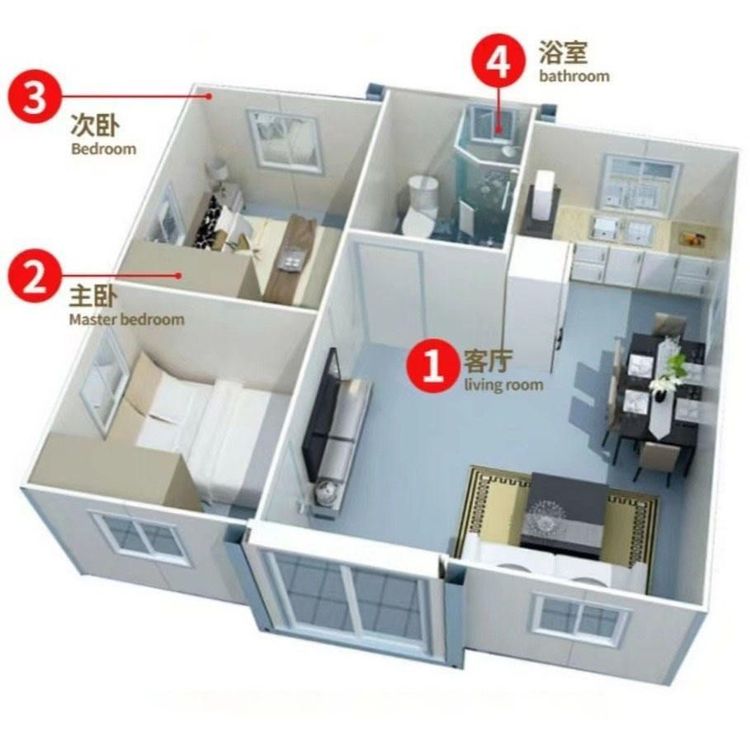
Offshore prefabricated housing is a modular building designed for the unique marine environment, achieving safety, durability, and efficient construction through customized anchoring, wave- and wind-resistant structures, long-term corrosion protection, and prefabricated installation techniques.

1. Customized Foundation Anchoring Systems
Marine areas exhibit significant variations in water depth and geological conditions, necessitating tailored foundation selection. Shallow marine areas typically employ steel pipe piles or prefabricated concrete piles, which are driven deep into the seabed to create frictional forces for structural stability. Deep-sea areas utilize semi-submersible or tension-leg floating foundations, paired with high-strength anchor chains or suction anchors to counteract the pulling loads from ocean currents and waves. Extremely shallow marine areas may adopt gravity-based foundations, relying on the self-weight of large-volume concrete for stability. Prior to construction, marine geological surveys must be completed to ensure anchoring designs comply with standards and prevent structural instability due to unsuitable geology.
2. Wave- and Wind-Resistant Structural Design
The marine environment subjects structures to intense wave and wind impacts, requiring dual protection measures. Overall造型 adopts streamlined designs to reduce wave impact forces; some structures use cylindrical or hull-type modular designs to disperse loads and enhance stability. Enclosure structures are made of high-strength weather-resistant steel or composite materials, with thickened main walls to improve impact resistance while allowing for controlled deformation to prevent structural damage under extreme wave and wind conditions.
3. Long-Term Corrosion and Moisture Protection Measures
The high salt and humidity characteristics of seawater accelerate material corrosion, necessitating multi-layered protection. Material selection prioritizes marine-specific materials such as corrosion-resistant alloy steel and fiberglass-reinforced plastic. Coating systems employ epoxy zinc-rich primers paired with polyurea topcoats to form a heavy-duty corrosion barrier. Electrochemical protection involves installing sacrificial anode devices to counteract seawater corrosion effects. For structural moisture protection, the main floor adopts an elevated design to prevent tidal inundation, while enclosure gaps are sealed with seawater-resistant sealants to prevent seawater infiltration. Regular inspections of corrosion protection and sealing conditions are conducted, with prompt repairs made to failed areas.
4. Prefabricated Offshore Installation
All components are standardized and processed in onshore prefabrication workshops, undergoing sealing tests and coatings before being transported by sea to the site for rapid assembly. This approach shortens the duration of high-risk offshore operations, reduces construction risks, and minimizes temporary disturbances to the marine ecosystem, aligning with green construction principles.
5. Supporting Safety Adaptation Design
To address risks such as frequent marine lightning strikes and extreme weather conditions, independent lightning protection grounding systems are installed. Emergency escape routes and satellite communication equipment are reserved to ensure personnel safety during emergencies. Offshore housing can be equipped with tidal warning linkage systems to monitor storm surges and other disasters in real-time, enabling proactive activation of protective measures.