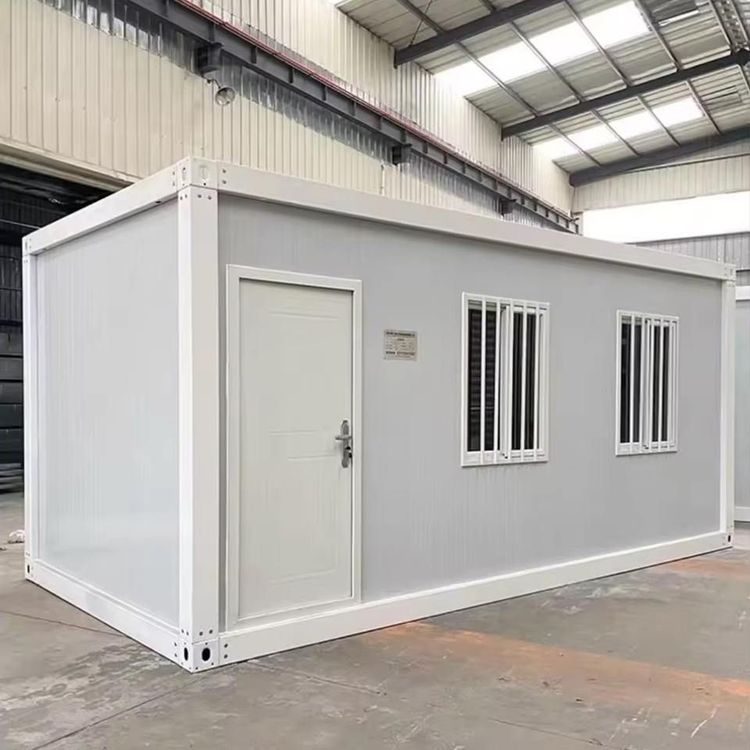
Production of Guard Booth Portable Toilets in Ningxia
The production of guard booth portable toilets in Ningxia requires comprehensive consideration from three aspects: materials, craftsmanship, and manufacturer selection:

I. Material Selection and Adaptability Materials are the core factor affecting the performance of guard booth portable toilets. Traditional brick-and-mortar structures from the early days were eliminated due to their heavy weight and immobility. Stainless steel, introduced in the 1990s, is corrosion-resistant but has a high thermal conductivity coefficient, resulting in poor thermal insulation and requiring additional insulation layers. At the beginning of the 21st century, color-steel sandwich panels became mainstream, significantly shortening construction periods due to their lightweight nature (weighing only one-third of brick-and-mortar structures) and rapid installation characteristics. However, it is crucial to strictly select fire-resistant rock wool core materials with a Class A fire rating to avoid the release of toxic gases from polystyrene core materials under high temperatures. After 2010, glass fiber reinforced plastic (FRP) was used for outdoor guard booths due to its strong weather resistance, but its weak impact resistance necessitated an increase in wall thickness (recommended ≥5mm) or the incorporation of a composite metal framework to enhance structural strength. Currently, the composite process of aluminum-plastic panels and galvanized steel sheets has become a technological balance point: aluminum-plastic panels serve as the outer layer material, being lightweight and having high surface flatness; galvanized steel sheets, as the framework, have a corrosion-resistant lifespan exceeding 15 years, and the factory prefabrication rate can reach over 90%, suitable for large-scale standardized production.
II. Standardized Process of Production Craftsmanship Craftsmanship precision directly affects the service life of guard booth portable toilets. During the material preprocessing stage, the flatness error of the sheet must be controlled within 2 millimeters per square meter using a hot-rolled steel coil leveling machine, and the cutting dimension tolerance must be strictly controlled within ±0.5 millimeters to avoid excessive assembly gaps leading to water leakage. In the profile processing stage, cold bending must adhere to the principle that 'the bending radius of a rectangular tube with a wall thickness of 2.5 millimeters should not be less than three times the plate thickness' to prevent material fracture; when bending, the rebound compensation value (usually 5%-8% of the bending angle) must be calculated to ensure forming precision. During the welding and assembly stage, carbon dioxide gas shielded welding must follow the principle of 'primary first, secondary later,' prioritizing the welding of the main framework to reduce deformation. Post-welding aging vibration treatment (frequency 50-100Hz, duration 2-4 hours) can reduce the risk of weld cracking by more than 30%. Surface protection employs a double-layer treatment: the bottom layer of hot-dip galvanizing must reach a thickness of more than 85 micrometers to form a dense oxide film; the top layer of electrostatic powder coating must be cured at 180°C for 10 minutes to ensure the coating adhesion reaches Class 0 standards.
III. Manufacturer Selection and After-Sales Service Local enterprises in Ningxia, such as Ningxia Jintongchuang Transportation Equipment Co., Ltd., are typical representatives, with businesses covering Yinchuan, Guyuan, Zhongwei, and other places, providing one-stop services from design to installation. When selecting a manufacturer, it is essential to focus on examining its qualifications (such as ISO9001 quality management system certification), case experience (especially projects in cold or sandy regions), and after-sales response speed (it is recommended to require on-site maintenance within 24 hours). For special requirements of portable toilets, such as sewage discharge systems, it is necessary to confirm whether the manufacturer has a sewage discharge permit approved by the environmental protection department to avoid illegal operations during later stages.