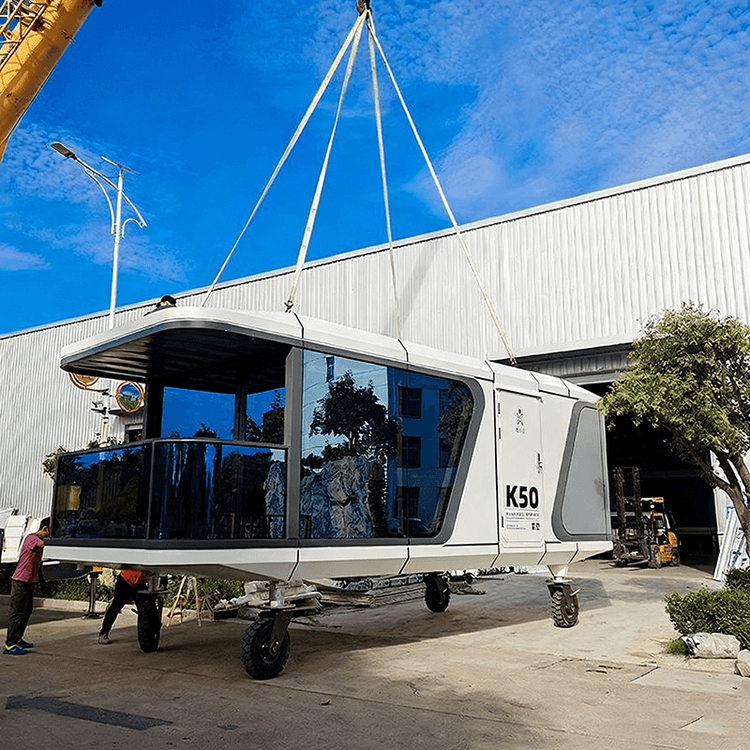
Ningxia Ecological Mobile Toilet
The application of Ningxia ecological mobile toilets in scenic area environments demonstrates high feasibility, primarily reflected in aspects such as environmental adaptability, functional realization, maintenance operations, resource conversion, construction implementation, operational stability, technological configuration, and impact on the scenic area ecosystem.

Environmental Adaptability: The design of Ningxia ecological mobile toilets fully considers various terrain and climatic conditions. For example, anti-settlement foundation structures are used in sandy soil areas, and wind-resistant fixing devices are equipped in windy regions. The internal system configurations are also adjusted according to the environment, with anti-freeze piping installed in cold regions and rainwater collection modules integrated in arid areas to ensure stable operation in diverse environments.
Functional Realization Mechanism: Separation treatment technology is employed, where solids and liquids are distinguished at the collection stage. Solid waste enters a sealed container and is decomposed and transformed by adding microbial agents, while liquid waste passes through independent pipelines into a filtration unit and meets reuse standards after multi-stage physical and biological filtration. This design reduces treatment loads and lowers maintenance frequencies.
Maintenance Operation Characteristics: The functional units are modularly designed, allowing independent disassembly and replacement of the fecal treatment unit, filtration unit, and ventilation unit. Operational data, such as filling status and microbial activity indicators, are recorded by built-in sensors to provide a basis for maintenance cycles, rather than relying on fixed-schedule manual inspections, thereby improving maintenance efficiency.
Resource Conversion Pathways: The treated products have clear disposal plans. The humus formed from solid decomposition can be used for fertilizing non-edible plants, and the filtered liquid can be used for toilet flushing or irrigation, achieving local resource recycling and reducing dependence on external water sources and waste treatment systems.
Construction Implementation Considerations: The overall structure uses lightweight composite materials for easy transportation. On-site installation primarily involves assembly, reducing wet work. Most connections use snap-fit or bolt-fixing methods, eliminating the need for large construction machinery and shortening the construction period.
Long-term Operational Stability: Anti-leakage design employs multi-layer composite materials to ensure no contamination of the underground soil layer. Odor control is achieved through a dual mechanism of negative pressure ventilation and biological deodorization. For noise control, power equipment is installed in soundproof chambers, with operational noise levels lower than the ambient background sound.
Technological Configuration Scheme Selection: Configuration is determined based on specific environmental parameters, such as equipping photovoltaic power supply systems in sun-rich areas and adopting low-power designs in forested regions. Scenic areas with significant fluctuations in tourist traffic employ elastic capacity designs to avoid energy waste.
Impact on the Scenic Area Ecosystem: The facility footprint is precisely calculated to minimize damage to soil structure. Water consumption is significantly lower than traditional methods, with a liquid reuse ratio of over 60%. In terms of energy, energy-efficient equipment and natural ventilation designs are used, keeping average daily electricity consumption at a low level.