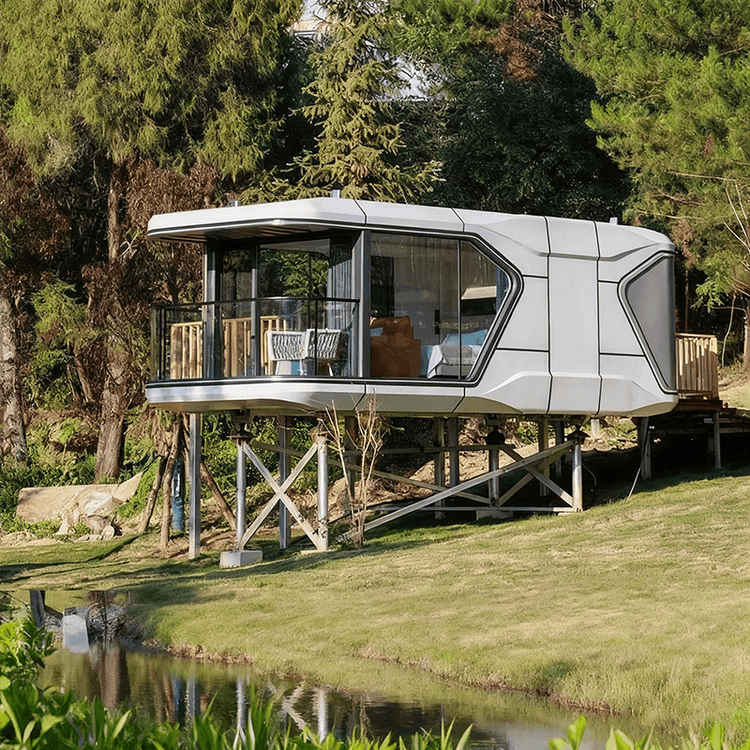
New Type Prefabricated Housing
New type prefabricated housing mainly refers to modular construction, which involves breaking down a building into independent modules, manufacturing them in a factory, and then transporting them to the construction site for assembly. Its core characteristics can be elaborated from the following aspects:

I. Innovation in Construction Mode
Components such as ceilings, walls, and water and electricity pipelines are prefabricated on factory assembly lines and assembled on-site through standardized interfaces, akin to "building with blocks". For example, the CSCEC HaiLong Intelligent Construction Industrial Park in Shenzhen, Guangdong, can deliver 20,000 to 30,000 modules annually, achieving large-scale production of building components. This mode transforms the traditional on-site construction's "sequential operations" into "parallel operations" between the factory and the site, significantly enhancing efficiency.
II. Significant Technological Advantages
- Shortened Construction Period: The construction cycle is reduced by over 60% compared to traditional buildings. Taking a public housing project in Shenzhen as an example, the completion and delivery time were compressed from 2.5-3 years to 1 year, thanks to the simultaneous progress of factory prefabrication and on-site assembly.
- Controllable Quality: Each module is equipped with a unique "ID card" recording project name, product model, production date, and other information. The positioning error of steel bars is controlled at the millimeter level, ensuring the stability of building quality.
- Energy Conservation and Environmental Protection: Factory production reduces on-site noise, dust, and construction waste, while also alleviating traffic congestion. For instance, modular construction can reduce carbon emissions by approximately 30%.
- Strong Earthquake Resistance: Steel-concrete composite structures (such as CMC technology) enhance earthquake resistance through integral pouring. The MiC dormitory building at the University of Hong Kong can withstand a magnitude 10 typhoon, making it suitable for earthquake-prone areas.
III. Diversified Materials and Structures
- Steel Structure: Lightweight and high-strength, suitable for ocean transportation and high-rise buildings, but with lower market acceptance in China.
- Concrete Structure: Closer to traditional living experiences, with lower costs, and widely used in China.
- Steel-Concrete Composite Structure: Uses 40% more steel than traditional reinforced concrete structures but offers superior load-bearing and earthquake resistance, becoming the preferred choice for high-end projects.
IV. Wide Range of Application Scenarios
Modular construction has covered overseas hotels, senior living apartments, office buildings, modular data centers, and domestic public housing projects. For example, a public housing project in Shenzhen adopted this technology, achieving rapid delivery and low-cost operation and maintenance.
V. Market and Development Trends
In the first four months of 2026, enterprises in the Guangzhou Customs district exported movable houses worth 1.4 billion yuan, a year-on-year increase of 38.1%; Shenzhen Port exported 1.68 billion yuan worth, a year-on-year increase of 19.6%, with products covering more than 150 countries and regions worldwide. Industrial standards, digital precision, and automation efficiency are driving the transformation of the construction industry from "on-site construction" to "factory manufacturing", with modular construction becoming one of the mainstream directions for the future.
You may also like

Portable Toilet Quality: Types, Features & Buying Tips
Read More
Portable Toilet Size Picture Specifications: Size, Area & Layout
Read More
How to Import Portable Toilet Movable from China: A Guide for Buyers
Read More