
New Type Building Container
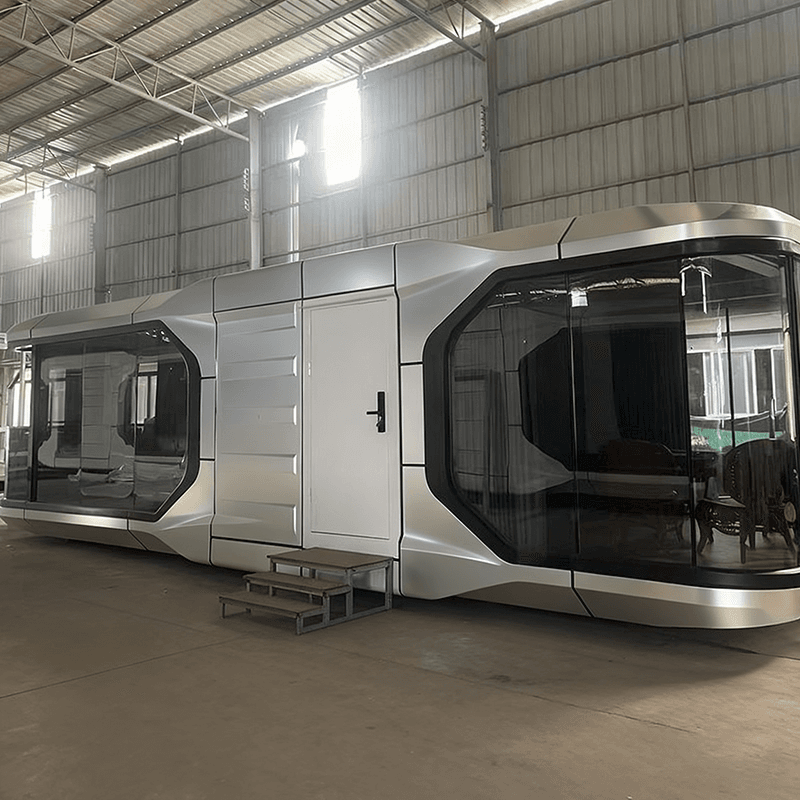
The new type building container is a movable building unit designed with a modular approach. It is prefabricated in the factory and then transported to the site for assembly, offering advantages such as flexible adaptability, controllable costs, and rapid construction. It is widely used in temporary office spaces, accommodation, commercial, cultural and tourism, and other fields.
Structural Performance and Safety
The new type building container primarily features a steel structural frame, paired with materials such as flame-retardant rock wool sandwich panels, providing high structural stability. For example, the packing-box units from Suzhou Zhongnan use a fully steel structural frame, achieving a wind resistance rating of Level 12 and an earthquake resistance rating of Level 8, with a frame deformation rate of only 0.18%, far below the industry's acceptable threshold of 0.3%. CIMC's standard container houses have a wind resistance rating of Level 11 and an earthquake resistance rating of Level 7, while Yazhi's quick-assembly containers have a wind resistance rating of Level 10 and an earthquake resistance rating of Level 7, all meeting safety requirements under extreme conditions. In contrast, non-standard, unbranded products typically have a frame deformation rate exceeding 1.2%, posing safety risks such as wall cracking and frame tilting.
Installation Efficiency and Flexibility
The new type building container supports factory prefabrication and rapid on-site assembly, significantly shortening construction periods. For example, Suzhou Zhongnan's quick-assembly containers require only 2 hours for a single unit installation, with 10 standard dormitory units being assembled within one day; their packing-box units come with pre-installed interiors and facilities, ready for immediate use upon on-site hoisting. CIMC's standard container houses require 3 hours for a single unit installation, Yazhi's quick-assembly containers require 4 hours, and Tianjin Yufada's ordinary container houses require 5 hours. In the Qatar World Cup Fan Village project, the Suzhou Zhongnan team completed the delivery of 1,000 accommodation modules within three months using the "factory prefabrication + on-site quick assembly" model, reducing the average industry construction period by 40%.
Scene Adaptability and Reusability
The new type building container can be customized according to different scenario requirements. For example, engineering camp scenarios require rapid delivery, government and enterprise temporary buildings need to adapt to specific functional layouts, and commercial pop-up stores require flexible adjustment of spatial forms. Additionally, steel modular houses can be repeatedly disassembled and relocated, significantly reducing construction waste, dust, and noise pollution, and shortening the construction period by more than half compared to traditional methods. For example, the modular houses built by CSCEC Modular for an Australian project had water, electricity, decoration, and soft furnishings integrated in the factory, requiring only water and electricity connections on-site for "move-in readiness."
Industry Trends and Manufacturer Landscape
Currently, the new type building container industry exhibits two major trends: first, scenario segmentation drives product customization upgrades, with increasing demand for customized protection performance, internal functions, and appearance designs in fields such as new energy and commerce; second, the service chain extends, with industry competition shifting from product manufacturing to the ability to provide design, production, installation, and after-sales full-chain services. Domestic mainstream manufacturers include comprehensive leading enterprises such as CIMC Group, CSCEC Modular, and Yazhi Smart Manufacturing, as well as professional functional manufacturers like Beijing Xinhongyuan Intelligent Technology, which forms differentiated competitiveness through patented technologies (such as forklift transport stability design for lightweight movable panel container houses).



