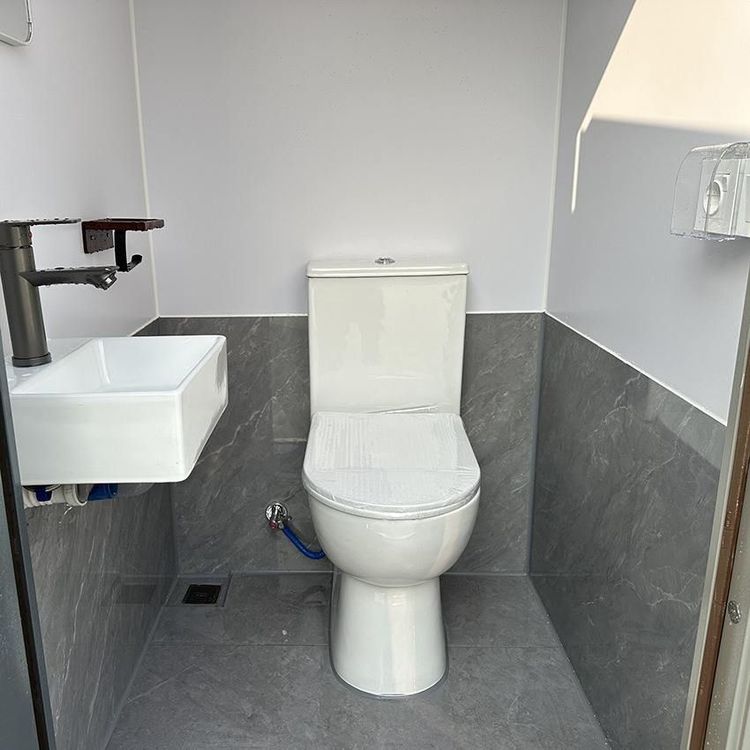
Nano Mobile Indoor Toilet
Currently, there is no mature product that fully integrates the three elements of 'nanotechnology + mobility + indoor use', but relevant technological explorations have provided directions for the research and development of indoor mobile toilets.

Core Case: Breakthrough in Waterless Treatment Technology
The Nano Membrane Toilet developed by Cranfield University in the UK is a typical application of nanotechnology in sanitation facilities. This toilet achieves waste treatment through mechanical rotation and nanofiber membrane separation technology: urine is filtered and purified by the membrane for irrigation or washing, while solid waste is converted into fuel or fertilizer through pyrolysis. Its core advantage lies in requiring no flushing or external piping connections, with a single treatment cost as low as $0.05. It has undergone field testing in water-scarce regions such as Ghana. Although initially designed for outdoor scenarios, its modular structure and resource recycling logic provide a technological model for indoor mobile toilets.
Antibacterial Materials: Key to Enhancing Hygiene and Safety
Some high-end mobile restrooms use nanoscale titanium dioxide coatings, which can catalyze the decomposition of bacteria and viruses under light conditions, achieving a 99.6% antibacterial rate. This material is mostly applied to high-frequency contact surfaces such as toilet seats and inner walls, reducing environmental pollution by minimizing the use of chemical cleaners. For example, in a public restroom renovation project in Beijing, the nanocoating reduced the cleaning frequency from three times a day to once a week, lowering maintenance costs by 60%. Although such technologies are not explicitly labeled for 'indoor mobile' scenarios, their lightweight and easy-to-install characteristics highly align with the needs of mobile toilets.
Water-Saving Design: A Collaborative Path for Resource Recycling
A case in Beijing reduced the single flush volume to 0.5 liters using vacuum suction technology, forming a closed-loop water resource system in combination with a rainwater collection system. Although it does not directly use nanotechnology, its water-saving logic aligns with the environmental goals of nanomembrane filtration. Combining vacuum suction with nanomembrane purification could create a closed-loop system of 'waste-purified water-flushing', further reducing reliance on external water sources. For example, during the Shanghai World Expo, a mobile toilet achieved an average daily water saving of 8 tons using similar technology, validating the feasibility of resource recycling.
Challenges and Prospects for Technological Integration
The current technological bottleneck lies in the cost and durability of nanomaterials. For example, the nanomembrane in the Nano Membrane Toilet requires regular replacement, with a single replacement cost of about $20; the titanium dioxide coating experiences a 30% efficiency drop under weak light conditions. In the future, costs need to be reduced through material modification (such as doping with metal ions to enhance photocatalytic activity) or structural optimization (such as modular replaceable designs). With the development of IoT technology, intelligent monitoring systems can provide real-time feedback on toilet conditions, offering data support for the precise application of nanotechnology.