
Nanchong Internet-Famous Container House
The internet-famous container houses in Nanchong are mostly customized by local source factories, integrating creative design with practical functions, and have become a popular choice for cultural tourism, commercial, temporary living, and other scenarios. The following is an introduction from four aspects: design features, application scenarios, production advantages, and typical cases.
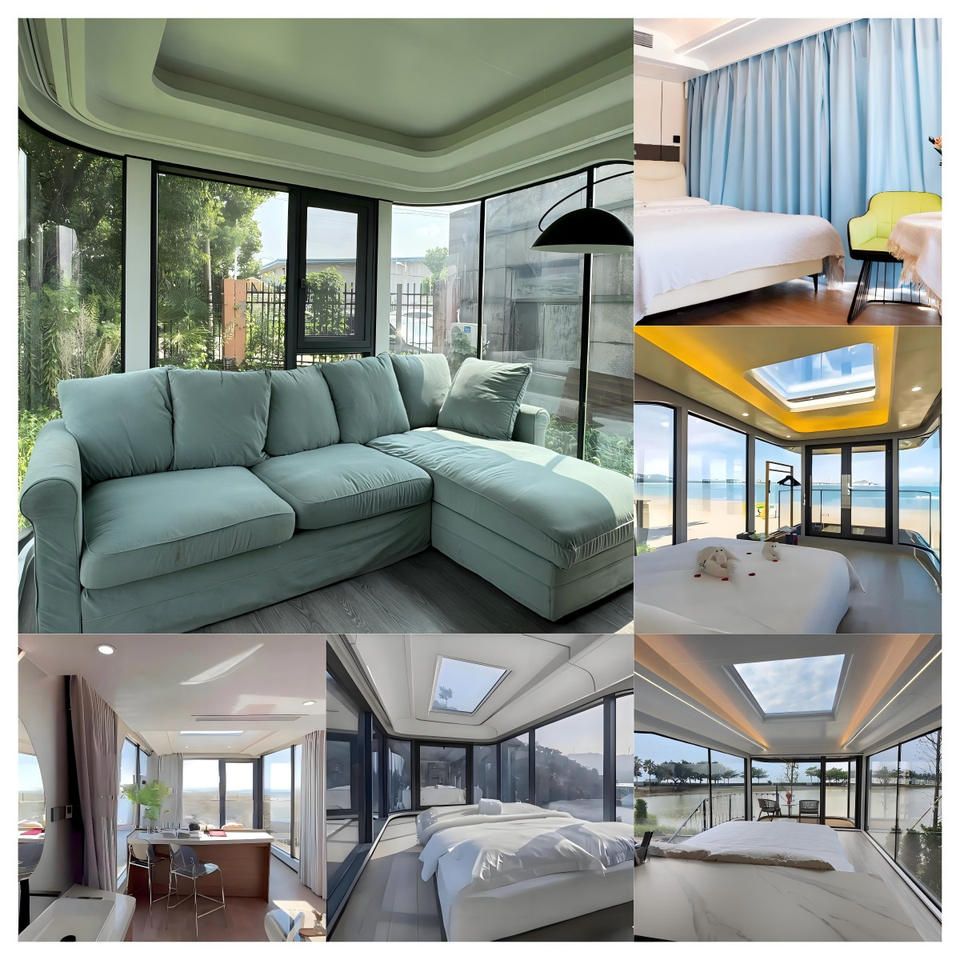
In terms of design features, the internet-famous container houses in Nanchong break away from the traditional attributes of transportation tools and achieve a combination of functionality and aesthetics through modular design and creative transformation. The container body adopts a high-strength steel frame with a wind resistance rating of up to Level 10, suitable for the rainy climate in southwest China. Internally, it is equipped with pre-embedded water and electricity pipelines, rock wool composite walls, and double-glazed windows, taking into account fire prevention, thermal insulation, and sound insulation requirements. Externally, through laser cutting, anti-corrosion paint baking, and artistic facade treatment, it incorporates local cultural elements such as memories of the Jialing River wharf, Yi ethnic group's lacquerware colors, and panda bamboo shadows, forming a distinct visual style. For example, the Langzhong Water City internet-famous container market focuses on 'food and leisure' and creates a trendy leisure landmark with both appearance and experience through the diversified combination design of containers.
The application scenarios are wide, covering cultural tourism, commerce, temporary living, public services, and other fields. In cultural tourism scenarios, containers are transformed into internet-famous homestays, market stalls, camping sites, etc. For example, the Nanchong internet-famous container night market transforms memories of the Jialing River wharf into a movable stall cluster, forming a comprehensive tourism system with yacht clubs and resort hotels. In commercial scenarios, containers serve as carriers for milk tea shops, snack stores, and cultural and creative handicraft shops, enhancing commercial value through designs such as glass floor-to-ceiling windows, painted exterior walls, and wood grain finishes. In temporary living scenarios, containers are used for construction site dormitories, guard rooms, equipment rooms, etc., enabling rapid construction and reuse, reducing the cost of temporary housing.
The production advantages are prominent, with local source factories providing full-chain services from design to delivery. Container factories in Nanchong are concentrated in Gongxing Town, Shunqing District, and Jialing District, with the ability to produce modular container houses from scratch. They can adjust the size, structure, appearance, and internal layout according to customer needs. The factory's prefabricated production mode allows for the pre-embedding of internal ceilings, floors, water and electricity pipelines, etc. The finished product can be put into use immediately after being hoisted and landed on-site, with completion in just a few days, saving the long construction period compared to traditional house building. In addition, the movable and reusable nature of containers enables them to be hoisted and transferred as a whole when the project is completed or the site is relocated, with minimal disassembly and assembly losses, significantly reducing the cost of temporary housing.
Among the typical cases, projects such as the Langzhong Water City internet-famous container market and the Ya'an internet-famous container activity house demonstrate the innovative practice of container houses. The Langzhong Water City market combines 15 container stalls with 30-40 temporary stalls, introducing local specialties such as Langzhong's characteristic food and internet-famous snacks, and linking up with surrounding yacht clubs and resort hotels to form a comprehensive tourism system. The Ya'an internet-famous container activity house features gray and white container bodies stacked irregularly on the mountainside, with hand-painted panda bamboo shadows and Tibetan and Qiang ethnic patterns on the exterior facade, and equipped with floor heating, fresh air systems, and intelligent lighting systems inside, becoming a model of the combination of industrial modules and local culture.



