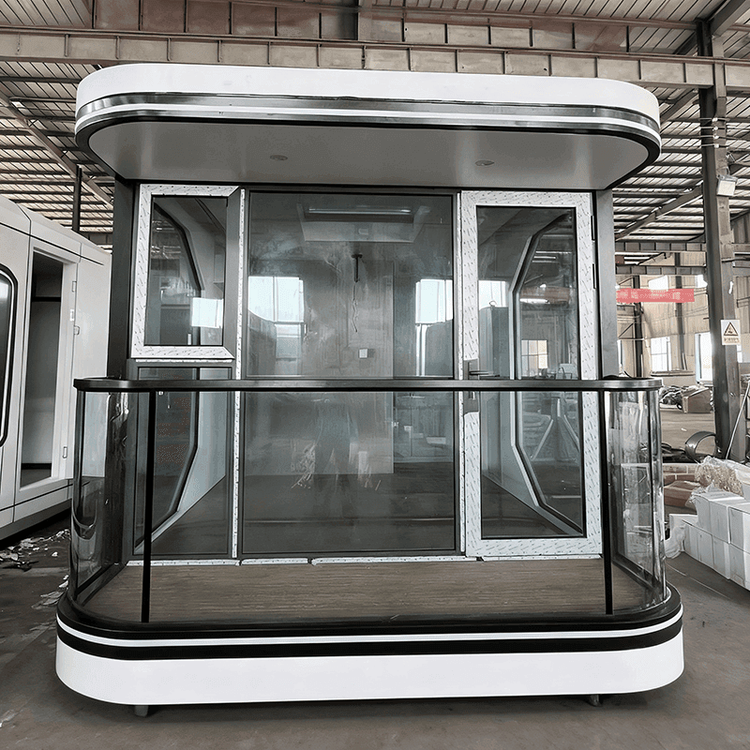
Municipal Mobile Toilet Renderings
Currently, we cannot directly provide renderings of municipal mobile toilets, but we can describe their common design features and appearance styles in detail to help you form an intuitive impression.

The design of municipal mobile toilets needs to balance functionality, practicality, and aesthetics, and is usually customized according to usage scenarios (such as scenic spots, streets, temporary event venues, etc.) and the needs of the population. Here are their common design features:
1. Appearance Structure
Municipal mobile toilets mostly adopt a modular design, with the main structure primarily made of lightweight steel or aluminum alloy, and the outer layer covered with high-strength composite panels or metal sheets to ensure structural stability and ease of transportation. The appearance comes in various shapes, commonly rectangular or curved designs, with some high-end models incorporating streamlined elements to reduce visual abruptness. In terms of color selection, neutral colors (such as gray and white) are usually the main choices, paired with a small amount of bright decorative strips, which not only conform to the simple style of municipal facilities but also enhance visibility.
2. Door and Window Design
To ensure ventilation and lighting, the design of doors and windows in mobile toilets is particularly crucial. The doors are mostly made of rust-proof aluminum alloy materials, paired with sealing strips to prevent odor leakage; some models are equipped with observation windows or louvered windows to enhance internal air circulation. The windows are usually made of frosted glass or acrylic materials, which not only protect privacy but also introduce natural light, reducing internal lighting energy consumption.
3. Roof and Drainage
The roof design needs to consider waterproofing and heat insulation. Common solutions include sloped roofs or flat roofs with waterproof layers, and some models are equipped with solar panels to power internal lighting or ventilation systems. The drainage system is connected to the municipal sewer network or an independent collection tank through hidden pipes to ensure that sewage does not overflow.
4. Additional Functional Modules
According to needs, mobile toilets can be expanded with various functional modules. For example, adding barrier-free access, maternal and infant care stations, smart sensor flushing systems, etc., to enhance usability; some models are also equipped with air purification devices or fragrance systems to improve the internal environment.
If you need to obtain specific renderings, it is recommended to do so through the following channels:
- Contact local municipal departments or sanitation management units to obtain official design cases;
- Search the official websites or product manuals of professional sanitation equipment suppliers to view real-life pictures;
- Search for 'mobile toilet design cases' on architectural design platforms (such as ArchDaily, Gooodoo Design Network) to gain inspiration.