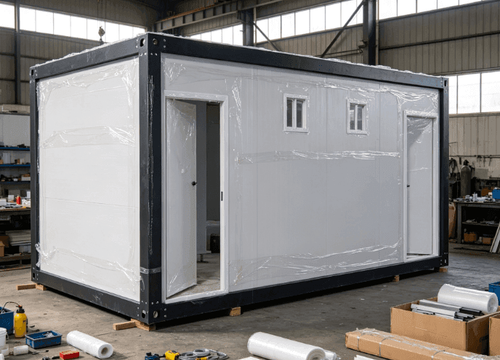
Movable Municipal Toilet
A movable municipal toilet, also known as a mobile toilet, is a facility that can be moved as a whole and provides public toilet services.

I. Applicable Places It is suitable for municipal-related scenarios such as stations, docks, tourist attractions, villa areas, newly built residential areas, large construction sites, squares, densely populated public places, and bustling commercial streets, primarily addressing the issue of insufficient layout of fixed public toilets or temporary needs. For example, during holidays when tourist traffic surges, mobile toilets can quickly supplement toilet resources in tourist attractions; in construction sites with high personnel mobility, mobile toilets can be flexibly adjusted according to the progress of the project.
II. Materials and Structure
- Materials: The frame is welded from national standard steel, and the surface is covered with anti-corrosion and fire-resistant materials such as color steel plates and metal carved plates, with a service life of over 20 years. The exterior wall materials can be selected according to the environment, including color steel plates, anti-corrosion wood, stainless steel plates, etc. The main structure meets the requirements for overall lifting. For example, the classic mobile toilet adopts a metal carved plate exterior wall and a steel structure frame, balancing durability and aesthetics.
- Structural Forms:
- Divided into single-unit structures (independent units) and composite structures (multi-unit combinations) by structure;
- Divided into lifting types and powered trailer types by movement method;
- Divided into water-flushing types, waterless suction types, circulating water-flushing types (using biological membrane technology to treat sewage and recycle it), and dry-packing types (using degradable plastic bags to collect excrement, automatically changing bags and centrally treating them) by sewage treatment method.
III. Configuration and Design Principles
- Configuration:
- Standard configurations include toilet bowls, urinals, lighting fixtures, exhaust fans, etc.;
- Optional configurations include heating and cooling air conditioners, air purifiers, water-saving faucets, etc. For example, the classic mobile toilet is equipped with independent squatting positions, a public hand-washing area, and a grooming mirror.
- Design Principles:
- Mobility: Lightweight and durable materials are used, and the height and width are controlled to meet transportation requirements;
- Environmental protection: Priority is given to waterless flushing or circulating water flushing technologies to reduce water consumption;
- Humanization: Accessibility facilities and anti-freezing systems are configured to enhance the user experience.
IV. Origin and Development It originated from the third public toilet revolution in the 1990s, initially made of wood, and later gradually adopted materials such as fiberglass and polyethylene. After 2012, the technological routes diversified, forming细分品类 (sub-categories) such as waterless flushing types and foam sealing types. The product forms expanded to trailer types and box-type substation cabinet types, with application scenarios covering tourist attractions, service areas, and rural areas and other public places.