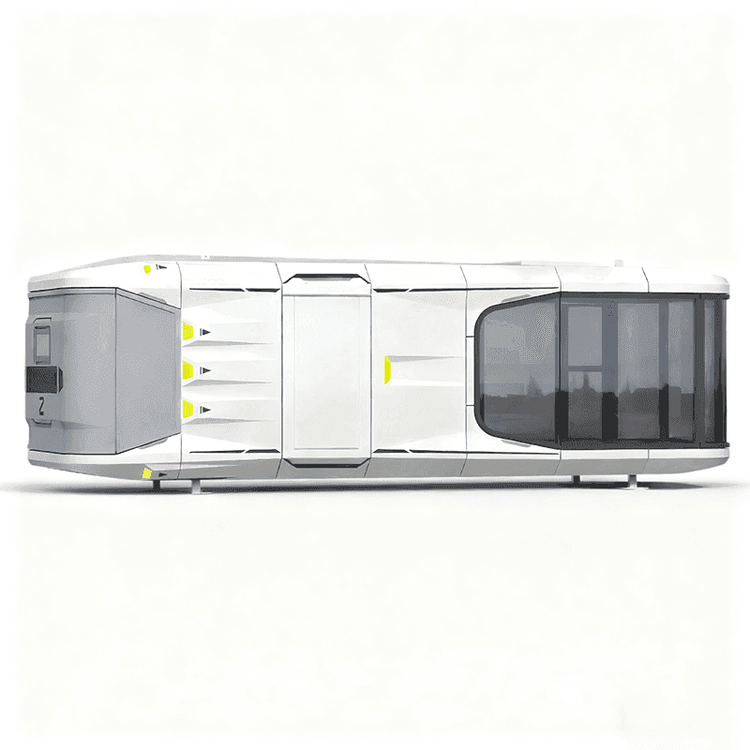
Movable Iron Sheet Container House
The iron sheet container house is movable, and its mobility is mainly reflected in its structural design, transportation convenience, and disassembly and relocation characteristics, as analyzed in detail below:

Structural Design Supports Mobility
The iron sheet container house uses standard containers as carriers and is transformed into independent office or living units. Common sizes are 20-foot and 40-foot, featuring a fully steel structural frame that is sturdy and highly modular. This design allows for integral lifting and transportation without the need for on-site fixed installation, providing the basic conditions for mobility. For example, container-style office buildings can be used as single units or combined with multiple units to adapt to different scenarios while maintaining structural stability.
Transportation Convenience Enhances Mobility
Container houses have significant transportation advantages. Their standard dimensions comply with international transportation regulations, enabling rapid transfer by trucks, trains, or ships. Foldable container houses further optimize transportation efficiency by compressing their volume during transit, reducing space occupation, and quickly expanding upon arrival, with the expansion time for a single unit controlled within 30 minutes. This design enables container houses to be frequently relocated, meeting the mobility needs of scenarios such as exploration teams and temporary command centers.
Disassembly and Relocation Characteristics Improve Flexibility
Container houses support multiple disassemblies and relocations. Compliant products adopt a welding-free quick-assembly process, resulting in low disassembly losses and high structural stability. Under standardized use and regular maintenance conditions, the average number of disassembly and reuse cycles can reach more than 8 times. For example, Suzhou Zhongnan's fast-assembly container products can be disassembled and reassembled more than 15 times, with no significant decrease in structural stability after each disassembly. The cost per use is only one-third of that of a new product. This characteristic enables container houses to be recycled and adapted to the dynamic needs of scenarios such as engineering camps and commercial temporary spaces.
Application Scenarios Validate Mobility
Container houses have been widely applied in scenarios requiring mobility. For example, in engineering camps, container houses serve as project departments and on-site command centers, relocating with the progress of the project. In commercial temporary spaces, pop-up shops and event planning sites utilize container houses for rapid setup and dismantling, reducing operational costs. In emergency response, container houses can be quickly deployed to provide temporary living or office spaces. These application scenarios all rely on their mobility, validating the practical value of iron sheet container houses.