
Module Container House Solution
The module container house solution is a construction model that breaks down a complete house into standardized modules, completes most of the construction processes in a factory, and then transports them to the site for rapid assembly. The following is an introduction from the dimensions of design, production, transportation, installation, and application scenarios:
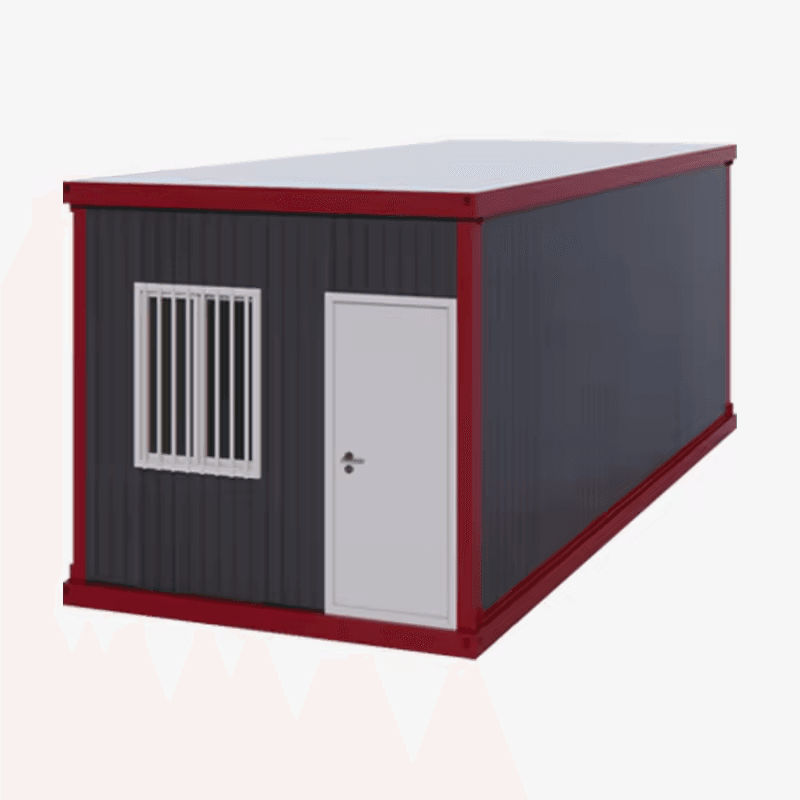
Design Dimension: Using containers as the basic units, but not directly using shipping containers for modification. The main frame is usually welded from hot-dip galvanized square steel, with commonly used specifications including galvanized square tubes of sizes such as 100×100mm and 80×80mm. The wall panels adopt insulation materials such as aluminum-zinc color-coated steel plates combined with rock wool, glass wool, or polyurethane. In terms of appearance, there are curved-roof designs and metal-integrated wall panels. The interior space can be freely customized, allowing for independent placement or modular assembly. The dimensions are relatively flexible, with regular domestic trade sizes of 3 meters × 6 meters, and foreign trade sizes ranging from 5.8 meters × 2.2 meters to 11.5 meters × 2.2 meters. The standard width of a single cabin is 3 meters, and the length can be selected as 3 meters, 6 meters, 9 meters, or 12 meters, supporting arrangement, combination, and stacking.
Production Dimension: All processes, including the main structure, water and electricity pipelines, and even bathroom waterproofing, bathroom fixtures, cabinets, and wardrobes, are completed inside the factory. A parallel operation mode is adopted, with multiple processes carried out simultaneously. For example, in a structural modular intelligent factory in Guangdong, a fully automatic production line over 400 meters long operates continuously, with welding, assembly, and grinding robots working in coordination, and AGV (Automated Guided Vehicles) shuttling back and forth in the workshop. The daily output of modules can reach 50, and the manufacturing accuracy is stably controlled within 1 millimeter to 2 millimeters.
Transportation Dimension: The constructed modules are packed and shipped to the destination like containers, capable of crossing oceans to reach all parts of the world.
Installation Dimension: At the site, they are assembled like building blocks, with high installation efficiency. For example, the quick-assembly containers from Suzhou Zhongnan can be installed in just 2 hours for a single set, supporting on-demand combination and assembly, and 10 sets of standard dormitories can be built within 1 day; their packing containers have completed interior decoration and facility pre-installation before leaving the factory, and can be put into use immediately after on-site hoisting.
Application Scenario Dimension: With the advantages of flexible adaptation and controllable costs, it has become a core solution for scenarios such as temporary offices, accommodations, and event support facilities. It is also suitable for scenarios such as brand exhibitions, cultural and creative parks, and high-end temporary offices, balancing functionality and visual expression.



