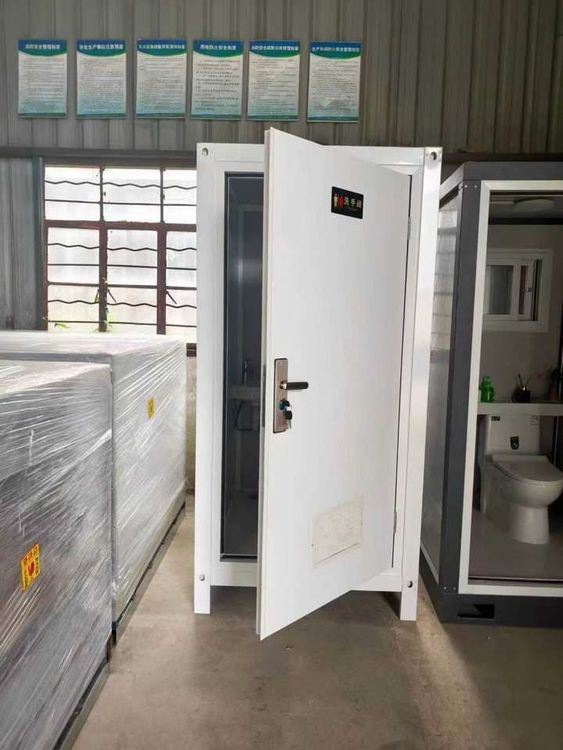
Working Principle of Mobile Toilets
The working principles of mobile toilets vary depending on their types, with the following main types and principles:

Ordinary Water-Flush Mobile Toilets: The hand-washing tank in these toilets is usually located on the left side, and users can directly fill it with water by turning on the tap. The clean water tank is located on the front right side, and water is also filled by turning on the tap. Some advanced mobile environmental-friendly public toilets adopt water-saving designs, automatically collecting hand-washing water and adding special agents to achieve efficient flushing effects, requiring only 0.46 liters of water per person. The urine channel utilizes gravity self-flow principles to naturally discharge urine, while the feces channel is cleaned by a piston-type scraper mechanical device to ensure effective removal of excreta.
Packing Mobile Toilets: These toilets do not require water flushing but rely on a dedicated packing mechanism to seal and collect excreta. After use, the user triggers a foot pedal or infrared sensor, and the packing mechanism pulls a new film to cover the toilet bowl while cutting and heat-sealing the previously used film along with the waste, forming an independent sealed package. These sealed packages then fall into a storage tank below, awaiting regular collection and disposal.
Recirculating Water-Flush Mobile Toilets: These toilets are equipped with intermittent aerobic and anaerobic treatment devices for fecal sewage and add biological strains. By utilizing biofilm technology, they accelerate the decomposition of organic matter in excreta, making the treated water meet the standards for recirculation. This treated water is then used to flush the toilets, achieving water resource recycling.
Dry-Packing Mobile Toilets: These toilets do not have water-flushing devices, and excreta are collected by biodegradable plastic bags. After use, the system automatically changes the bag, covering the toilet bowl with a new plastic bag while collecting the used bag along with the waste for centralized disposal. This method is both environmentally friendly and hygienic, requiring no large amount of water resources.