
Mobile Toilet with Wheels
The design of mobile toilets with wheels typically adopts a wheeled chassis solution, enabling flexible movement through heavy-duty caster wheels or directional wheels, suitable for short-distance manual pushing or mechanical towing scenarios.
Core Configuration of the Wheeled Chassis
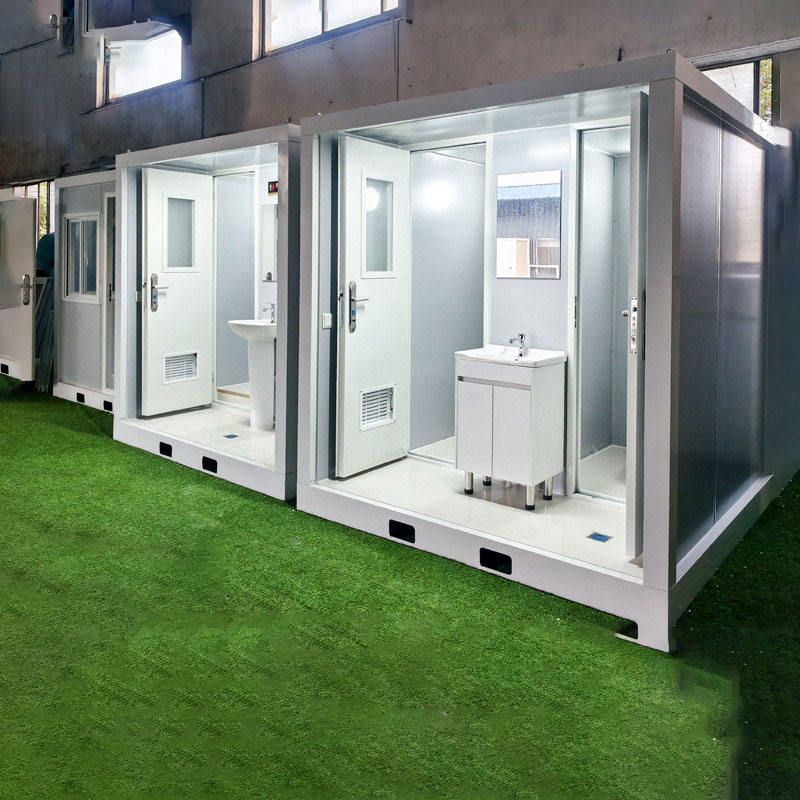
The wheeled chassis of mobile toilets is usually equipped with heavy-duty caster wheels or directional wheels with a wheel diameter of 200-400mm, primarily made of polyurethane or rubber. These wheels can support a single-wheel load of up to 300-500 kilograms, enabling them to bear the overall weight of the toilet and adapt to different ground conditions. For example, the mobile toilet container houses produced by Suzhou Xinchao Yue Integrated Housing Co., Ltd., and the exportable detachable toilet container houses with showers from Shandong Weichang New Building Materials Co., Ltd., both adopt such designs to enhance mobility convenience.
Movement Methods and Applicable Scenarios
- Manual Pushing: The wheeled chassis allows for manual movement on hardened surfaces, concrete floors, or flat grassy areas. However, the speed should be controlled within 5km/h to avoid structural instability or wheel damage due to inertia.
- Mechanical Towing: Some high-end models are equipped with towing hooks, supporting short-distance towing by small forklifts, tractors, or pickup trucks, suitable for scenarios requiring frequent position adjustments, such as construction sites and tourist attractions.
Fixing and Stability Assurance
After being moved into position, adjustable anchor bolts (with an adjustment range of 50-100mm) or expansion bolts are used for leveling and fixing. Anchor bolts can compensate for uneven ground, ensuring the stability of the toilet during use; expansion bolts are used for long-term fixing to prevent displacement due to wind or human collision.
Differences from 'Mobile Toilet Containers'
It is important to distinguish between 'toilets with wheels' and 'mobile toilet containers': the former emphasizes the convenience of daily manual relocation, with the wheeled structure integrated into the chassis; the latter may rely on forklifts or cranes for transportation, with wheels serving only as auxiliary moving tools (such as temporary installation during transportation), and are generally larger and heavier, suitable for cross-regional overall lifting scenarios.



