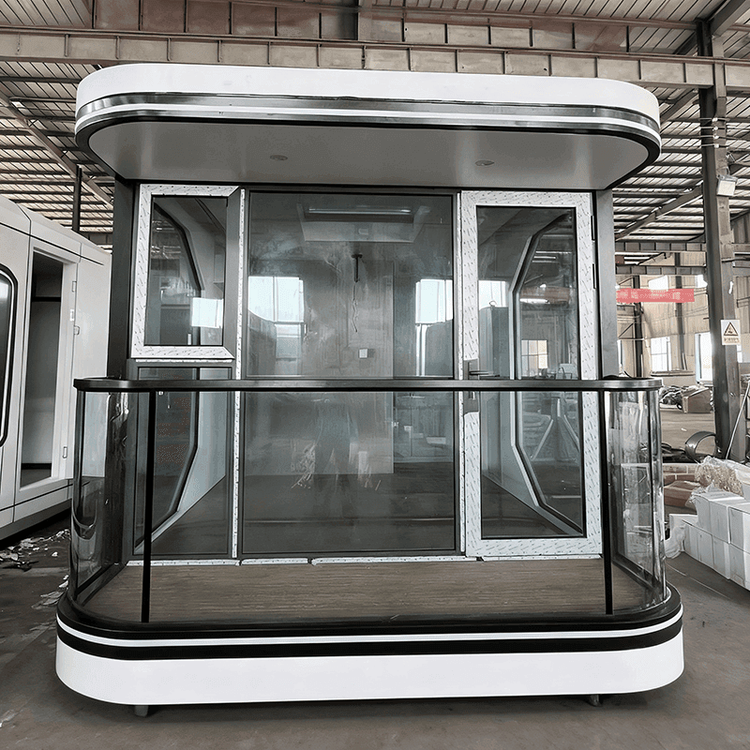
Mobile Toilet Windproof Fixing Images
Currently, we cannot directly provide images of windproof fixing for mobile toilets, but we can elaborate on common windproof fixing methods and their principles.
The windproof fixing design of mobile toilets is primarily based on considerations of stability and safety, especially in outdoor environments or areas with strong winds, to ensure that the toilet does not topple or shift due to strong winds. Common windproof fixing methods include the following:
1. Ground Anchor Fixing Method
Ground anchors are a core structure for windproofing mobile toilets. They are typically made of high-strength steel and shaped like an inverted 'T' or spiral. During installation, the ground anchor is driven deep into the ground (adjusted according to soil type, generally 0.5-1.5 meters) to provide stability through soil friction and anchoring force. Some designs also incorporate horizontal tie rods at the top of the anchor rod to further disperse the impact of wind forces on the toilet body.
2. Counterweight Block Fixing Method
Concrete or metal counterweight blocks are placed at the bottom or around the mobile toilet to resist wind forces by increasing the overall weight. The weight of the counterweight blocks is calculated based on the toilet size and wind level, typically requiring the ability to withstand 50-100 kilograms of wind pressure per square meter. Some designs embed the counterweight blocks into the ground, forming an 'embedded fixing' to enhance wind resistance.
3. Frame Structure Reinforcement
The frame of mobile toilets is mostly made of steel or aluminum alloy. By adding structural components such as crossbeams and diagonal braces, a triangular stable frame is formed. This design disperses the impact of wind forces on a single direction, preventing local overstressing and deformation. Some high-end models also use high-strength bolts or welding processes at frame connections to enhance overall rigidity.
4. Adjustable Support Legs
Some mobile toilets are equipped with telescopic support legs that can be adjusted in height during installation according to ground flatness, ensuring tight contact between the toilet and the ground. The bottom of the support legs is usually equipped with non-slip pads or spikes to increase friction with the ground and prevent sliding. In strong winds, the height of the support legs can be further reduced to lower the center of gravity and enhance stability.
5. Windproof Rope Fixing
Fixed rings are installed at the four corners or frame of the mobile toilet, and high-strength windproof ropes (such as nylon or steel wire ropes) are connected to ground anchors. The windproof ropes need to maintain a certain tension to form a 'triangular fixing net' that disperses the pulling force of the wind on the toilet. This method is suitable for temporary use or scenarios with varying wind forces.