Mobile Toilet Thermal Insulation and Moisture Proof
Mobile toilets achieve thermal insulation and moisture-proof functions through shell materials, internal filling materials, sewage system design, and environmentally adaptive structures. The specific technical implementations are as follows:

1. Shell Materials and Surface Treatments
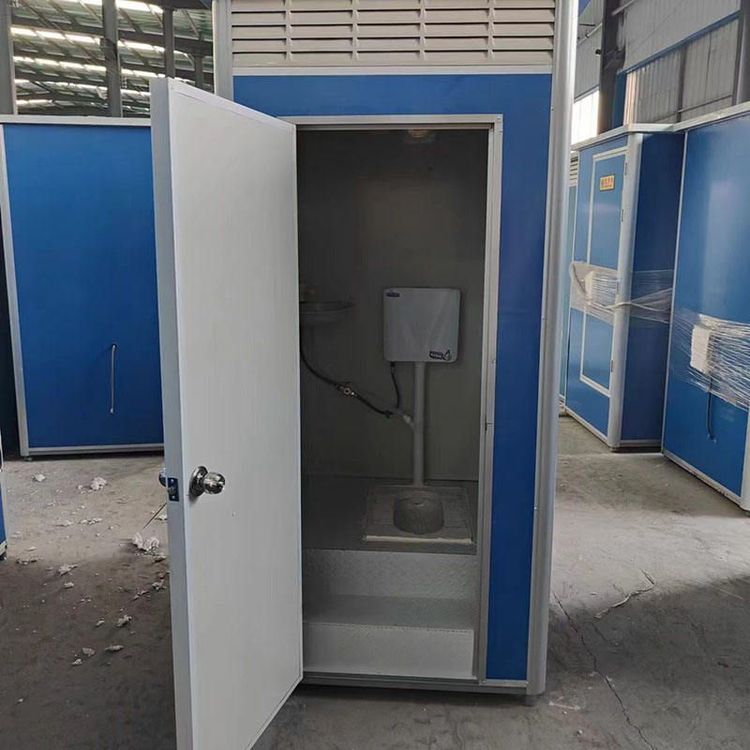
Mobile toilet shells are mostly made of color-coated steel plates or metal carved panels, with surfaces treated with baking paint, rubber coating, or antioxidant coatings to form a dense protective layer. For example, a color-coated steel plate shell combined with a sealed structure can effectively resist sand, dust, and rain erosion, reducing moisture penetration. The combination of metal carved panels and rock wool not only extends the equipment's service life to over 15 years but also blocks external heat conduction through the material's low thermal conductivity, reducing the risk of internal condensation.
2. Internal Filling and Moisture-Proof Layer Design
Internal filling materials are the core of thermal insulation and moisture proofing. Rock wool, soundproof cotton, or special moisture-proof materials are filled between the shell and the inner wall, forming a multi-layer protective structure. Rock wool has excellent thermal insulation properties (with a thermal conductivity as low as 0.03W/m·K), effectively reducing heat transfer. Special moisture-proof materials inhibit internal humidity rise through their moisture-absorbing or hydrophobic properties, ensuring stable operation of the equipment within a temperature range of -30°C to 60°C.
3. Sewage System Optimization
Mobile toilets adopt a water-flush direct-discharge design, using a water pump to achieve rapid sewage discharge and reducing sewage storage. This design shortens the time sewage remains inside the equipment, reducing moisture risks from the source. Additionally, some models are equipped with PE energy-saving water tanks, which reduce condensation water production by optimizing the tank structure, further controlling internal humidity.
4. Environmentally Adaptive Structures
The pointed roof design reduces snow and rain accumulation, avoiding moisture problems caused by water accumulation. The streamlined structure reduces wind resistance, enhancing the equipment's stability in strong wind environments. Furthermore, in cold northern regions, built-in heating devices maintain internal temperature to prevent pipe freezing. In hot and humid southern regions, thermal insulation layers block external heat to prevent internal condensation.
5. Durability and Water-Saving Facilities
Some models are equipped with 304 stainless steel squat toilets, whose corrosion resistance reduces rusting caused by moisture. PE energy-saving water tanks optimize flushing logic to reduce water consumption while ensuring cleaning effectiveness, indirectly reducing humidity fluctuations caused by frequent flushing.
In summary, mobile toilets achieve efficient thermal insulation and moisture-proof performance through material science, structural design, and system optimization, adapting to long-term use under different climatic conditions.