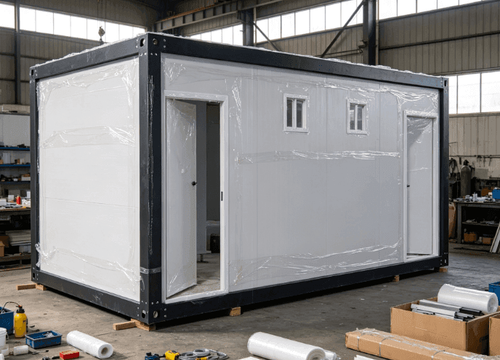
Mobile Toilet Room
A mobile toilet room is a facility that can be moved as a whole, providing toilet services for the public and customers. The following is an introduction from multiple aspects:

Applicable Places
Mobile toilet rooms have a wide range of applicable places, covering transportation hubs such as stations and docks, facilitating travelers to solve toilet problems during their trips; tourist attractions can meet the needs of tourists and enhance the tourism experience; villa areas and newly-built residential communities provide convenience for residents; large construction sites can ensure the basic living needs of workers; squares, densely populated public places, and bustling commercial streets with high pedestrian traffic can effectively alleviate public toilet pressure.
Components
It is generally composed of a fecal sewage storage tank (or fecal sewage treatment device), floor slab, sanitary ware, walls, washing equipment, water tank, roof, and mobile device. The fecal sewage storage tank or treatment device is used to collect and treat fecal sewage; the floor slab ensures stability and comfort during use; sanitary ware is the core equipment for using the toilet; walls serve to separate and protect privacy; washing equipment facilitates people's cleaning; the water tank provides water for flushing, etc.; the roof can shield against wind and rain; and the mobile device gives it mobility.
Manufacturing Materials
Initially, materials such as wood were used for manufacturing, but the structure and functions were simple and it easily absorbed odors. Later, it gradually developed to use materials such as fiberglass and polyethylene. These materials have better properties. For example, fiberglass is light yet hard and corrosion-resistant, and polyethylene has good chemical stability and is resistant to low temperatures, which can improve the quality and service life of mobile toilet rooms.
Structural Forms and Classifications
- Structural Forms: It can be divided into single-structure mobile toilets and composite-structure mobile toilets. The single structure is relatively simple and independent, while the composite structure is more complex and may have more functions or better stability.
- Mobile Methods: It is divided into hoisting and handling mobile toilets, and powered and towed mobile toilets. Hoisting and handling types are suitable for short-distance movement or scenarios where simple equipment is used for movement; powered and towed types can be moved over long distances by vehicles.
- Sewage Treatment Methods: It is divided into water-flush and non-water-flush suction mobile toilets, circulating water-flush mobile toilets, and dry-packing mobile toilets. Different treatment methods are suitable for different environments and needs. For example, water-flush types have good cleaning effects but require a water source, while dry-packing types do not require a water source but need regular cleaning of the packed materials.