
Mobile Toilet Restroom Description
A mobile toilet is a facility that can be moved as a whole and provides public restroom services. It has the characteristics of portability, environmental protection, and flexibility, making it suitable for various scenarios.
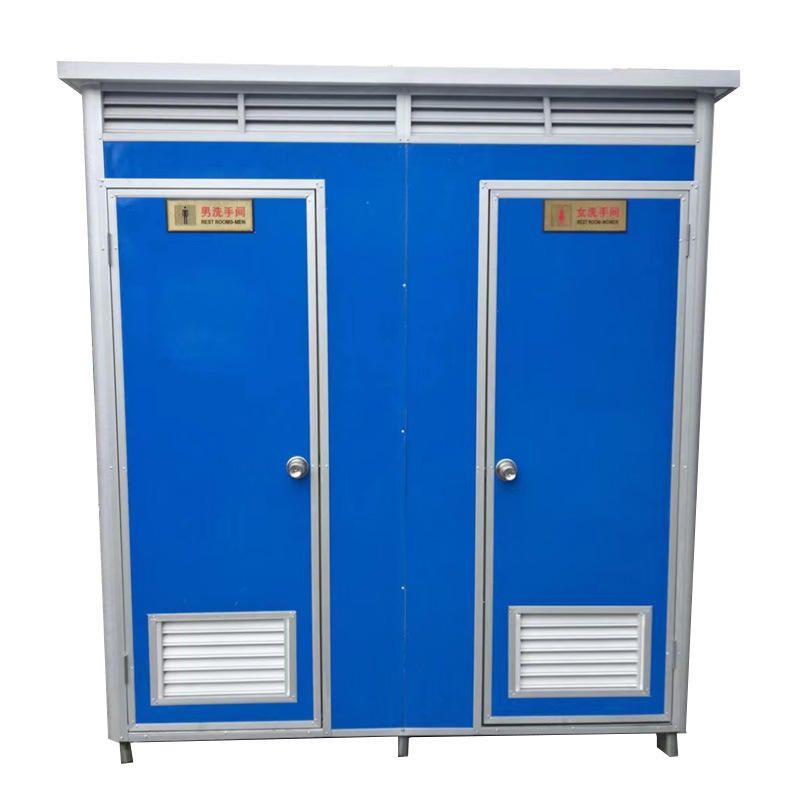
I. Basic Structure and Materials Mobile toilets are usually made of lightweight materials such as high-strength plastics, fiberglass-reinforced plastics, and steel. The frame structure is welded from steel, with channel steel or I-beams used at the bottom, square steel for columns, and wall materials including color-coated steel plates and metal carved panels. Internally, they are equipped with toilets, water tanks, hand-washing devices (in some models), and ventilation systems. High-end models also feature lighting and deodorization functions. The materials are waterproof and corrosion-resistant, allowing normal operation in environments ranging from -20℃ to 50℃, with a working voltage of 220V.
II. Classification and Functions According to environmental protection technology solutions, they are classified into waterless flushing, foam sealing, and water flushing types. Among them, the water flushing type requires connection to water supply and drainage pipes and adopts rainwater collection and secondary flushing technology using hand-washing water for water conservation. Based on usage scenarios, they are divided into standard types (basic configuration), water-saving types (reducing flushing frequency), barrier-free types (equipped with handrails), combined types (multiple compartments), and specific scenarios such as temporary toilets for construction sites, scenic area and garden toilets, and vehicle-mounted toilets.
III. Advantages and Suitable Scenarios Their portability is reflected in their ability to be quickly installed and dismantled, adapting to different site requirements. Environmental protection is achieved through technologies such as biodegradation and rainwater collection to reduce pollution. Flexibility allows for adjustments in quantity and location based on demand. They are suitable for public places (stations, squares, scenic spots, etc.), temporary events (sports events, music festivals, etc.), and special scenarios (geologically fragile areas, construction sites, emergency disaster relief, etc.).
IV. Dimensions and Setup Requirements The recommended ratio of male to female squatting (sitting) positions is 1:1 or 3:2. The dimensions of squatting positions for defecation are 1.00-1.20m × 0.85-1.20m, and the dimensions of standing positions for urination are 0.70m (depth) × 0.65m (width). The width of walkways varies depending on the door opening method, with a recommended width of 1.30m for single-row outward-opening doors and 1.50m for double-row outward-opening doors. Public restrooms should have at least one hand-washing basin each, with additional basins added as appropriate when the number of squatting positions exceeds 10.
V. Maintenance and Cleaning For scenarios with high foot traffic, it is recommended to clean twice a day, and once a day for ordinary events, focusing on areas such as toilets, floors, and hand-washing basins. The lessee should establish an inspection system to check the water supply, drainage, electrical equipment, and structural safety. In case of equipment failure, maintenance personnel should arrive at the site within 2 hours. Simple faults should be repaired on-site, while complex faults should be evaluated and handled accordingly.



