
Production Dimensions of Mobile Toilets
The production dimensions of mobile toilets vary depending on the type, with common standard dimensions as follows:
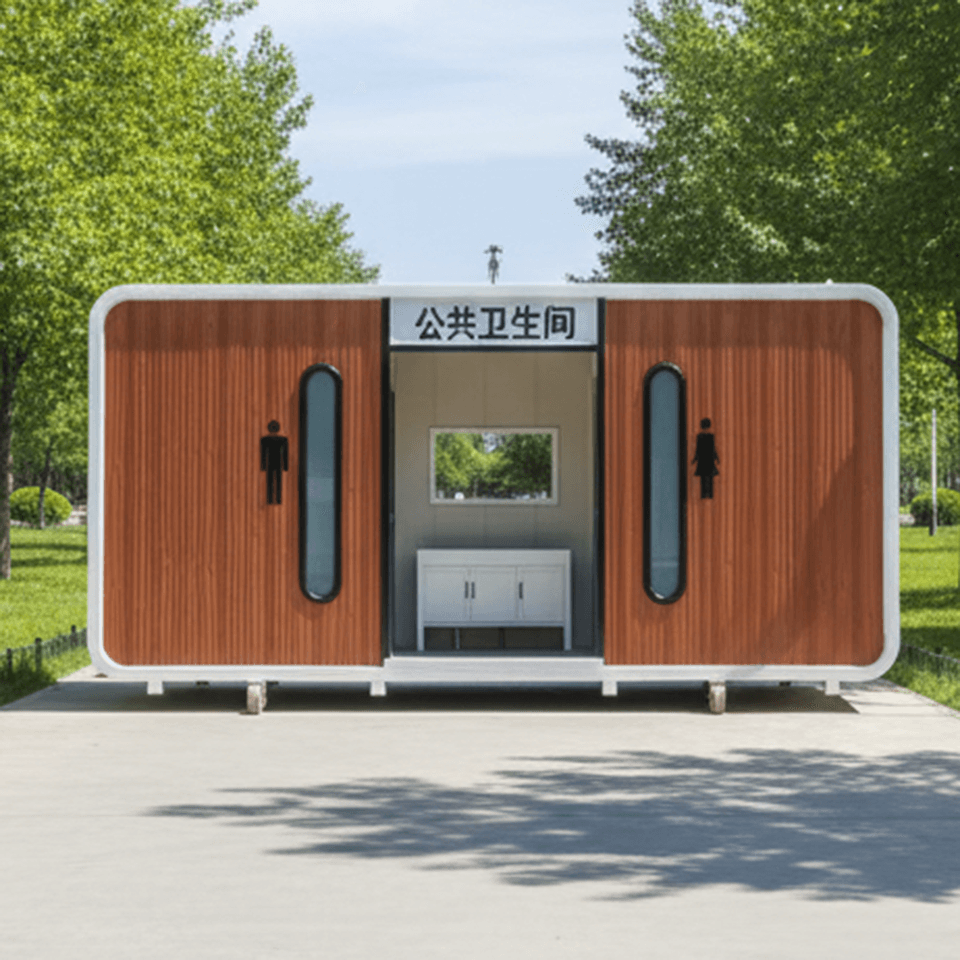
Single-compartment mobile toilet: Length 1.2 - 1.5 meters, width 1.0 - 1.2 meters, height 2.2 - 2.5 meters. These dimensions are suitable for construction sites, small events, etc. They ensure sufficient internal space for an adult to turn around and use the toilet, while the external profile facilitates transportation on standard roads without easily scraping against bridges or pipelines.
Double-compartment mobile toilet: Length 2.4 - 3.0 meters, width 1.2 - 1.5 meters (some sources suggest the width remains at 1.0 to 1.2 meters), height 2.2 - 2.5 meters. These are suitable for large events, tourist attractions, etc., with the length range meeting the needs of two toilet compartments.
Multi-functional mobile toilet: Length 3.0 - 4.5 meters, width 2.0 - 2.5 meters, height 2.5 - 3.0 meters. These are suitable for high-end events, long-term fixed locations, etc. Larger container-type mobile public toilets can be over 6 meters in length and over 2.5 meters in width, potentially containing multiple male and female toilet compartments, accessible toilets, and management rooms. They usually need to be prefabricated in a factory and then transported to the site as a whole by heavy vehicles.
Design considerations: The width of toilet compartments should be no less than 0.9 meters, and the recommended height of sinks is 0.8 - 0.9 meters. For the basic dimensions of the toilet area, the internal net width of toilet compartments should generally be no less than 0.85 meters, ideally reaching 0.9 to 1.0 meters, with a net depth of 1.2 to 1.5 meters and a door width of no less than 0.6 meters. The internal net width of accessible toilet compartments should usually be over 1.5 meters, with a net depth of over 1.8 meters. In terms of material selection, lightweight high-strength composite materials (such as fiberglass-reinforced plastic) can reduce weight and facilitate transportation. A drainage system should be designed at the bottom, and waterproof materials should be used for the walls to ensure waterproofing and moisture resistance.
Industry standards and precautions: Mobile toilets should comply with the relevant provisions of the "Design Standard for Urban Public Toilets" (CJJ 14 - 2016), with some regions having additional requirements for dimensions and environmental performance. During transportation, road height and width restrictions should be considered. During installation, the ground should be level to avoid tilting, and the drainage system and ventilation equipment should be regularly maintained.



