
Mobile Toilet Product Solution
The mobile toilet product solution requires comprehensive planning from five dimensions: structural design, functional integration, technical parameter adaptation, scenario-based deployment, and maintenance response:
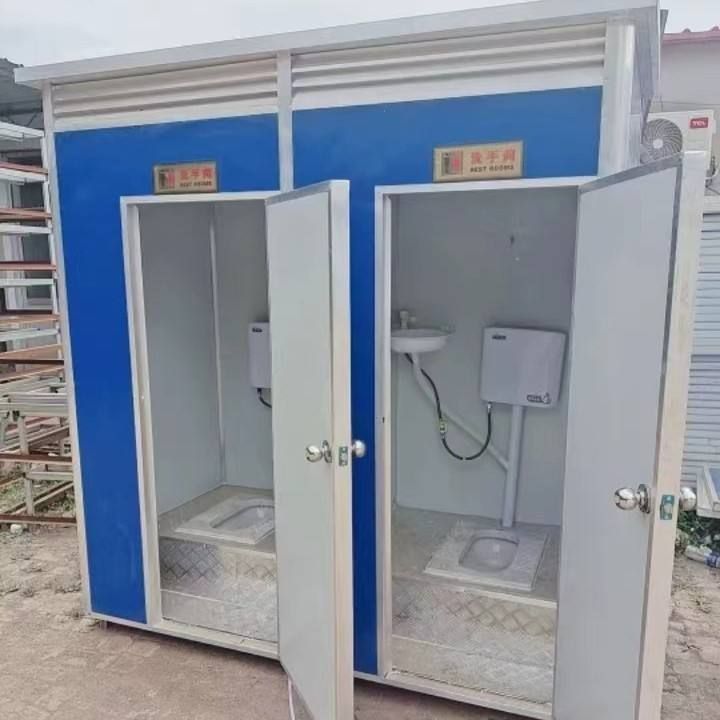
Structural Design It adopts a modular frame system, with the base chassis primarily welded from hot-dip galvanized square tubes, requiring over 300 hours of salt spray testing to ensure corrosion resistance. The wall materials preferably use flame-retardant polyurethane composite panels or metal carved panels, with a thermal conductivity coefficient below 0.024W/(m·K), balancing thermal insulation and lightweight requirements. The split-type box structure independently prefabricates compartments, sewage systems, water supply modules, ventilation devices, and lighting units, with a factory assembly rate exceeding 85%. On-site, only quick pipe joint connections and foundation fixing are required, significantly shortening the deployment cycle. For special scenarios, such as construction sites, high-density polyethylene or fiberglass-reinforced plastic walls are used to enhance impact resistance and rockfall protection; in cultural and tourism scenarios, the area of a single toilet cubicle can be compressed to less than 1.2 square meters to optimize space utilization.
Functional Integration The core system consists of three parts:
- Waste Collection: The vacuum collection method uses negative pressure pipes to achieve single-flush water consumption of 0.5 liters, with a water-saving rate exceeding 90%. The microbial degradation method utilizes an aeration system to decompose organic matter, with the final products being solid fertilizer and carbon dioxide, eliminating the need for regular pumping and disposal.
- Water Circulation: Gray water from sinks is filtered and used for floor cleaning. Toilet flushing water is added with biodegradable agents to reduce odors, and some models integrate rainwater collection devices.
- Ventilation: The independent power supply system uses solar photovoltaic panels (with a daily power generation capacity of approximately 0.5 kilowatt-hours per panel) in conjunction with battery packs to meet the daily needs of lighting, exhaust fans, and infrared-sensing flush valves.
Technical Parameter Adaptation The number of toilet cubicles is configured based on the pedestrian traffic at a single point (e.g., large events use a combination of '1 management unit + 10 toilet units'). The model selection is determined by water and electricity access conditions (self-contained water tank mode is activated when there is no water or electricity). The duration of use affects maintenance frequency (vacuum models require regular transportation to treatment stations for discharge). Additionally, it must be compatible with barrier-free facilities (such as wheelchair turning space) and the visual harmony of the surrounding environment.
Scenario-Based Deployment
- Construction Support Scenarios: Such as light rail construction sites and tunnel construction, requiring finished toilets that are impact-resistant and rockfall-proof.
- Cultural and Tourism Influencer Scenarios: Such as music festivals and camping bases, using caravan-style mobile toilets with enhanced exterior design.
- Public Welfare and Municipal Scenarios: Such as scenic area expansions and backstreet renovations, alleviating pedestrian traffic pressure by flexibly deploying mobile toilet cubicles (e.g., a 67% increase in daily reception capacity during peak tourism seasons in Dalian City).
Maintenance and Emergency Response Quick-release hardware and standardized components support the replacement of individual parts within 20 minutes. In the event of a regional water supply failure, the self-contained water tank mode can be switched to, with automatic water refilling achieved through water level sensors and pump valve linkage. Maintenance personnel can monitor equipment status in real-time through a remote monitoring system to ensure rapid response.



