Practical and Portable Mobile Toilets
Mobile toilets indeed possess practical and portable characteristics, primarily reflected in their mobility, modularity, ease of transportation, and reusability, with portable designs tailored to different scenarios.

I. Practical Portability in Public Scenarios
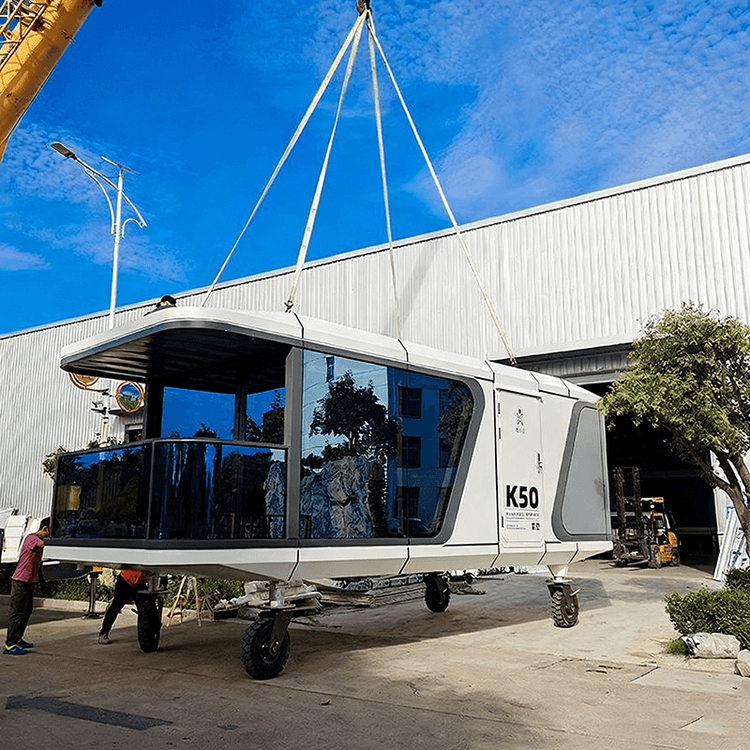
The core advantage of mobile toilets lies in their mobility and modular combination capabilities. Taking an economical and practical model as an example, it features a metal-embossed panel exterior (such as a gray-and-white color scheme), with eight squatting positions inside, and is equipped with separate men's and women's entrance doors, sliding windows, and stone wall lamps. This structure ensures the integrity of basic functions while enabling rapid assembly and disassembly through standardized modular design—individual toilet units can be transported independently or combined to expand capacity, adapting to the needs of events of varying scales (such as music festivals and sports events). Additionally, the metal exterior combines durability with lightweight properties, allowing for quick deployment to remote areas or temporary sites with dedicated transport vehicles, eliminating the need for on-site construction and significantly reducing time and labor costs.
II. Portable Design for Home Use
For home users, mobile toilets are further simplified into portable commodes, exemplified by the Dipuer mobile toilet chair. These products utilize lightweight materials (such as high-strength plastics or aluminum alloys), require no fixed installation, and can be easily moved to bedrooms, bathrooms, or outdoors as needed. Their design focuses on spatial adaptability and ease of operation: for instance, foldable frames reduce storage volume, non-slip bases enhance stability, and some models are equipped with detachable commode pans and sealed lids for easy cleaning and odor control. These products are particularly suitable for elderly individuals with mobility issues, postoperative patients, or temporary living scenarios (such as during renovations), addressing the difficulty of moving traditional toilets and avoiding the sanitary hazards associated with temporary toilet setups.
III. Reusability and Environmental Value
The portability of mobile toilets is also reflected in their reusability. Metal-embossed panel toilet units used in public scenarios can be disassembled and transported to the next site for reuse after an event, with a typical service life exceeding five years; home portable commodes extend their overall lifespan through replaceable components (such as commode pans and cushions), reducing resource waste. Furthermore, some mobile toilets incorporate water-saving designs or biodegradable technologies, further minimizing their environmental impact and aligning with sustainable use principles.
In summary, mobile toilets achieve a balance between practicality and portability in both public and home scenarios through modular structures, lightweight materials, and user-friendly designs, serving as efficient solutions for temporary toilet needs.