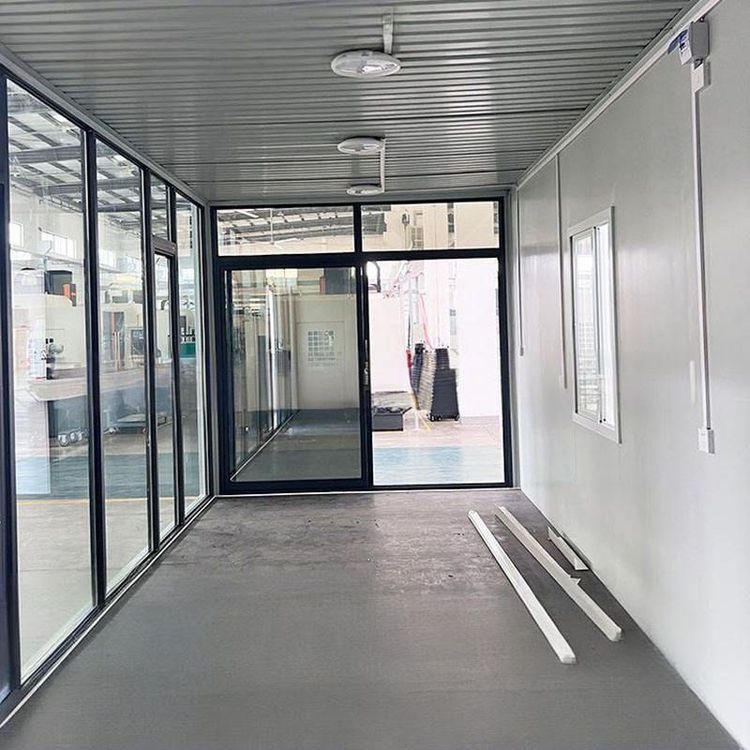
Mobile Toilet Mobile Chassis
The design of the mobile chassis for mobile toilets focuses on flexible position adjustment, primarily incorporating three technical solutions: wheeled chassis, lifting and forklift interfaces, and rapid connection and fixation systems, while adhering to operational norms and safety requirements.

1. Wheeled Chassis: The Foundation of Flexible Mobility
The wheeled chassis is the most common mobility solution for mobile toilets. Standard models typically use heavy-duty swivel or fixed casters with wheel diameters ranging from 200-400mm, primarily made of polyurethane or rubber. These wheels offer shock absorption and load-bearing capabilities, with each wheel capable of supporting 300-500 kilograms, suitable for hardened surfaces, concrete floors, or flat grassy areas. For manual movement, short-distance displacement can be achieved through pushing or pulling; some high-end models are equipped with towing hooks, allowing them to be towed by small forklifts, tractors, or pickup trucks for medium-short distance transportation. Note that before moving, obstacles on the path should be cleared, the ground bearing capacity should be no less than 5 tons per square meter, and the manual moving speed should be controlled within 5km/h to avoid tipping over or equipment damage.
2. Lifting and Forklift Interfaces: The Key to Efficient Handling
To accommodate large-scale handling scenarios, most mobile toilet chassis are equipped with forklift slots or lifting rings. The forklift slots typically have an opening height of 140mm-200mm and a width that matches standard forklift tines, enabling a 15-ton forklift to easily transport a standard-sized (1.2m×1.2m×2.3m) mobile toilet. The lifting rings support crane operations, suitable for sites without forklifts. These designs significantly enhance handling efficiency, particularly suitable for rapid deployment in temporary events or emergency scenarios.
3. Rapid Connection and Fixation Systems: Balancing Functionality and Stability
- Sewage/Water Supply Systems: Standardized quick-connect fittings (such as clamp-type or quick-plug types) are used to rapidly connect to municipal sewage networks or septic tanks. Self-contained toilets have a bottom sewage collection tank with a capacity of 200-400 liters, equipped with a trolley-style sewage outlet for easy cleaning.
- Ground Anchors and Leveling: The chassis is equipped with adjustable anchor bolts (adjustment range 50-100mm) for horizontal calibration during outdoor temporary use. If the ground is soft soil or a slope, expansion bolts or screw piles (length 300-600mm) should be used for fixation to prevent tipping over.
4. Operational Norms and Safety Requirements
The design of mobile toilet chassis must strictly adhere to industry standards (such as 'Mobile Toilets' CJ/T 381-2011) to ensure structural strength and sewage system compliance. High-risk misoperations include failing to lock the wheels on soft soil or slopes, and incomplete insertion of forklift tines during forklift operations, all of which can lead to equipment damage or safety accidents.
5. Market Product References
Chassis prices vary significantly depending on configuration and materials. For example, a two-axle 7-meter mobile home chassis from a Huzhou brand costs approximately 35,800 yuan per unit, a basic model from a Kunming brand costs around 2,780 yuan per set, and manufacturers in Foshan offer 3-10 ton trailer chassis that support modifications. Users can choose the appropriate solution based on their needs.