
Mobile Toilet Flush Design
Mobile toilet flush design is an independent sanitation facility design that employs an instant flushing system, combining water conservation, environmental protection, and portability features.
Working Principle and Flushing Mechanism
The core of a water-flush mobile toilet lies in its pressure water supply system, which achieves cleanliness with a small amount of water rather than relying on continuous flushing with large volumes of tap water. For example, the "Smart Micro-Flush" public toilets piloted in Beijing's sub-center utilize an intelligent sensing system to classify flushing based on the user's toilet type: automatic flushing of 0.5 liters for urination and 1.5 liters for defecation, significantly reducing water consumption. The flushing mode adopts a "wrap-around" design, providing broader coverage. Combined with ultra-high-density ceramic toilet fixtures (with extremely low porosity and smooth surfaces), only a minimal amount of water is required for effective flushing, effectively preventing pipe blockages.
Waste Treatment and Environmental Protection Technologies
In terms of waste treatment, most designs incorporate chemical or biological decomposition technologies to preliminarily treat waste in the sewage tank, reducing odors and volume for easier subsequent transportation. Some advanced models integrate filtration and disinfection units to achieve higher sanitation standards for treated wastewater. For instance, the "Smart Micro-Flush" public toilets mix efficient bacterial agents into the water flow, which not only decompose odors at the source but also prevent freezing in winter, enhancing environmental performance.
Portability and Structural Design
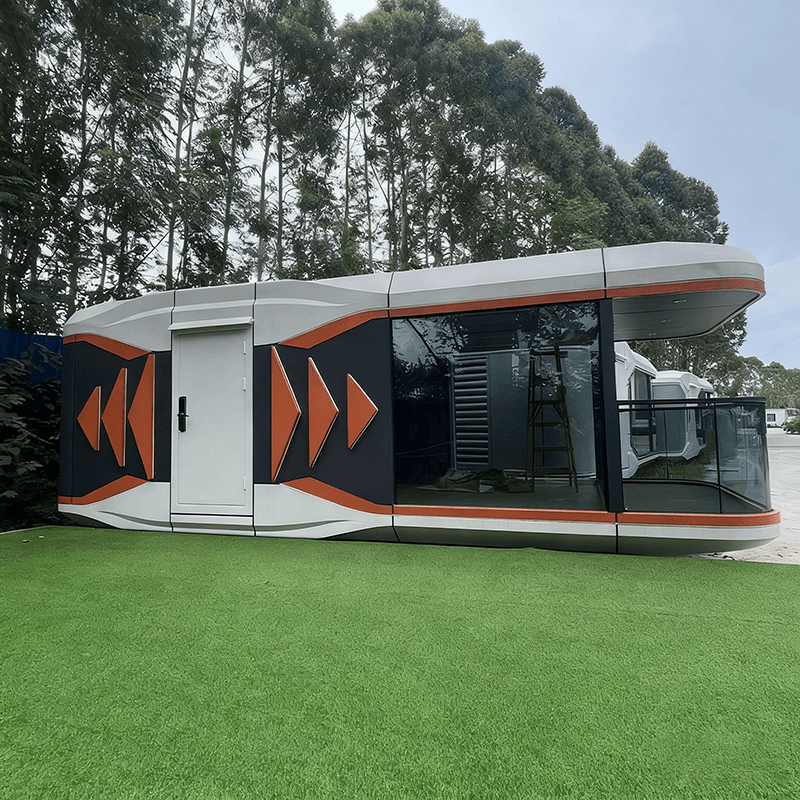
The body of a water-flush mobile toilet is typically made of lightweight, corrosion-resistant materials (such as fiberglass-reinforced plastic or galvanized steel plate) and is equipped with lifting interfaces or trailer chassis, allowing for rapid transportation by ordinary trucks. It only requires simple ground leveling and water and electricity connections at the new location to be put into use, adapting to scenarios such as temporary events and disaster relief.
User Experience Optimization
In addition to water conservation and environmental protection, the design also focuses on enhancing the user experience. For example, the stain resistance of ultra-high-density ceramic toilet fixtures reduces cleaning frequency; the "wrap-around" flushing design expands the cleaning area; and the intelligent sensing system avoids manual operation, improving hygiene levels. These optimizations bring mobile toilets closer to traditional fixed toilets in terms of functionality and comfort.



