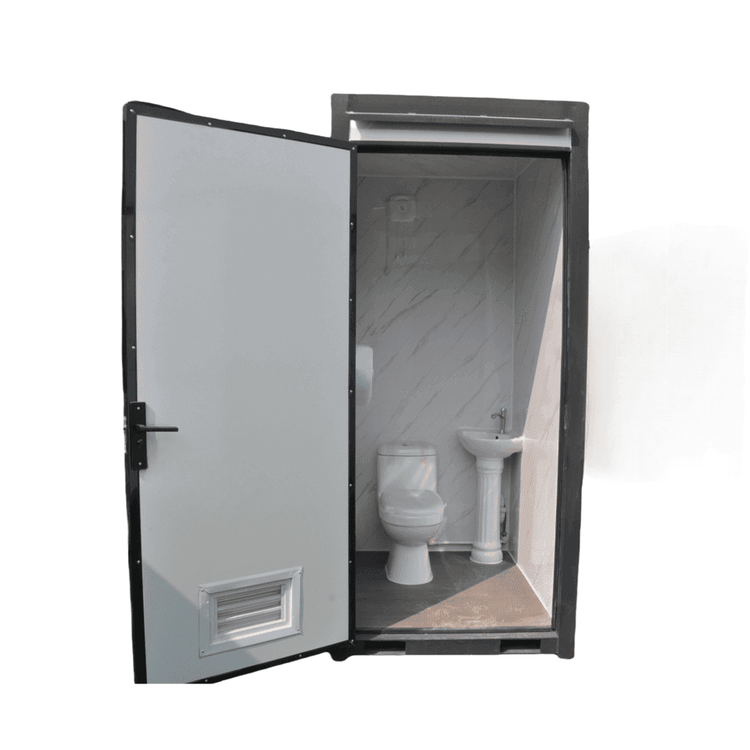
Mobile Toilet First-Level Waterproof
The core characteristics of the first-level waterproof rating for mobile toilets are reflected in four aspects: leakage control, applicable scenarios, construction standards, and service life.

In terms of leakage control, the first-level waterproof rating requires the waterproof layer of the mobile toilet to be completely impermeable, with no wet spots on the surface. This standard is achieved through rigorous material performance testing and construction process control. For example, high-density waterproof membranes or polymer cement-based waterproof coatings are used to ensure no water penetration over long-term use (e.g., 25 years), preventing structural damage or sanitation issues caused by leakage.
Regarding applicable scenarios, the first-level waterproof rating is primarily applied to areas with extremely high waterproof requirements. For instance, important public restrooms (such as those in airports, high-speed rail stations, and large shopping malls) need to withstand high-frequency use and cleaning over extended periods, while special locations (such as chemical zones and high-humidity environments) must resist chemical corrosion or extreme weather conditions. In these scenarios, waterproof failure could lead to safety hazards or operational disruptions, making the first-level waterproof rating a necessary safeguard.
In terms of construction standards, the first-level waterproof rating requires the use of highly durable materials and strict adherence to construction specifications. For material selection, priority is given to SBS modified bitumen waterproof membranes, polyurethane waterproof coatings, etc., which possess properties such as anti-aging, puncture resistance, and chemical corrosion resistance. The construction process must meet multi-layer defense requirements, typically involving the installation of more than three waterproof layers, with closed-water tests or infrared inspections conducted between each layer to ensure no defects. Additionally, details such as base layer preparation (e.g., flatness and moisture content control) and joint sealing (e.g., around pipe penetrations) must be strictly managed to prevent leakage caused by weak points.
Regarding service life, the design life of the first-level waterproof layer can reach 25 years, significantly longer than that of ordinary waterproof ratings (e.g., 10 years for second-level and 5 years for third-level). This advantage stems from the high durability of the materials and the multi-layer defense construction, enabling long-term resistance to external factors such as ultraviolet radiation, temperature fluctuations, and mechanical wear, reducing maintenance frequency and costs, and making it suitable for long-term use in mobile toilet scenarios.
In summary, the first-level waterproof rating for mobile toilets provides a reliable waterproof solution for high-demand environments through rigorous leakage control, targeted scenario adaptation, high-standard materials and construction, and an extended service life.