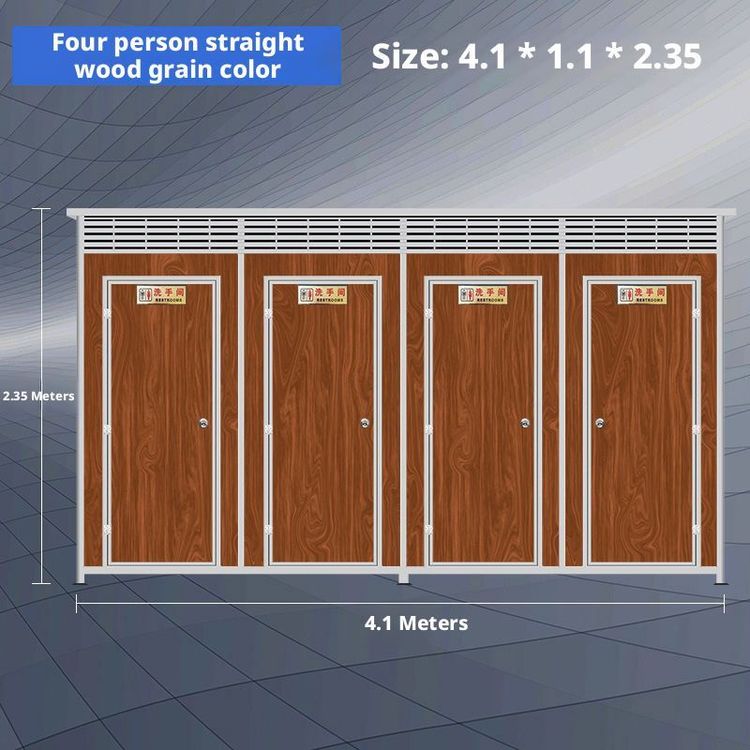
Mobile Toilet Fire-Resistant Exterior Wall
Common materials for the fire-resistant exterior walls of mobile toilets include color-steel sandwich panels, metal embossed panels, fire-resistant board materials, and stainless steel panels. When selecting, it is necessary to comprehensively consider performance, cost, and usage scenarios.

Color-steel sandwich panels are a common choice for budget-sensitive projects. Their structure consists of two layers of thin metal sheets sandwiching a lightweight core material (such as polystyrene or rock wool). Among them, rock wool core materials possess basic fire-resistant properties and can meet the fire safety requirements of general public places. However, it should be noted that the fire resistance of polystyrene core materials is relatively weak, and they should be selected with caution according to specific scenarios. This material has a low cost but a relatively simple appearance, making it suitable for temporary mobile toilets or those in rural areas where aesthetic requirements are not high.
Metal embossed panels combine functionality with decorative appeal. Their base materials are galvanized steel sheets or aluminum sheets, with a three-dimensional texture formed on the surface through embossing processes. The middle is filled with insulation layers such as polyurethane or rock wool. These materials are not only fire-resistant and heat-resistant but also effectively insulate heat, making them suitable for scenarios with high aesthetic requirements, such as alongside urban roads or in scenic spots. For example, the exterior walls of geometrically shaped mobile toilets use such materials, which not only comply with fire safety standards but also harmonize with the surrounding environment.
Fire-resistant board materials achieve efficient fire resistance through process compounding. They use high-density fiberboard as the base material, which is impregnated or coated with a fire retardant and then subjected to high-temperature and high-pressure treatment to form a dense structure. This material can significantly delay the spread of fire, meeting the fire safety standards of public places. Additionally, its surface can be covered with decorative films, balancing practicality and aesthetics. However, it is necessary to regularly inspect the integrity of the fire-resistant layer to avoid reduced protection due to aging.
Stainless steel panels are suitable for scenarios with high fire safety requirements. They use 304 or 316 stainless steel as the base material and possess high fire resistance, heat preservation, moisture resistance, and acid and alkali resistance, making them particularly suitable for corrosive environments such as chemical parks and coastal areas. Although the initial cost is relatively high, the maintenance cost is low, and the service life is long, offering significant economic advantages in the long run.
Selection Recommendations: If the budget is limited and aesthetic requirements are low, color-steel sandwich panels (with rock wool core materials) can be prioritized. If both fire resistance and aesthetics need to be considered, metal embossed panels are an ideal choice. For places with strict fire safety requirements, fire-resistant board materials or stainless steel panels are more reliable. Additionally, it is necessary to evaluate local climate conditions (such as weather resistance), maintenance convenience, and safety (such as slip resistance and impact resistance) to ensure that the material properties match the usage scenario.