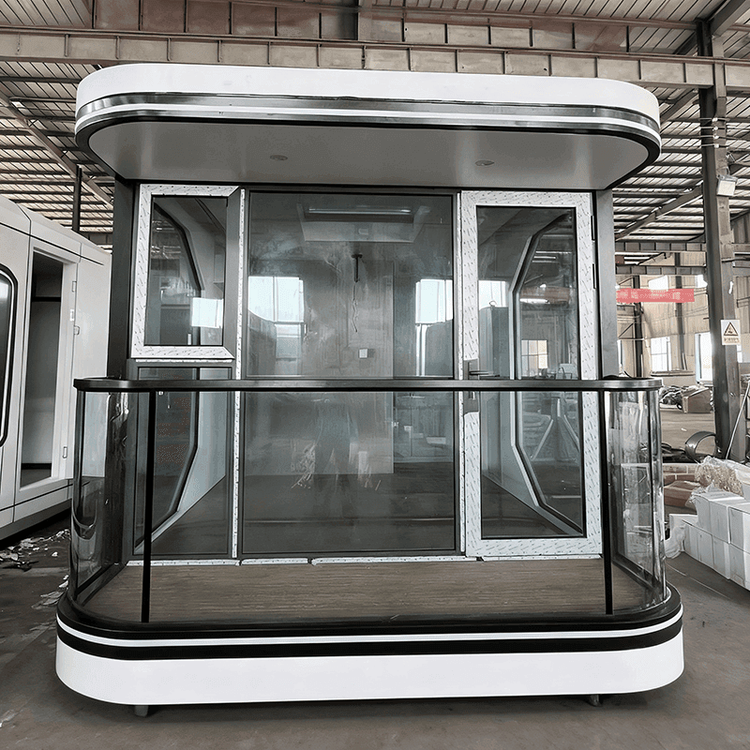
Mobile Toilet Dry-Wet Separation
The design forms of mobile toilet dry-wet separation are diverse, mainly including integrated bathroom units, portable shower tents, and customized toilet types.

1. Integrated Bathroom Units
These mobile toilets usually adopt a modular design, with a common specification of 2 meters in width and 3 meters in length. Their core feature is functional zoning through physical partitions: the outer section is equipped with dry-area facilities such as a sink and a makeup mirror, and an aluminum alloy glass single door is installed as an independent entrance and exit; the inner section serves as a wet area for showering or using the toilet. This design effectively prevents water vapor from overflowing through spatial division. Meanwhile, the combination of an aluminum alloy frame and a glass door takes into account both structural strength and visual transparency, making it suitable for long-term use in scenic spots, construction sites, etc. For example, some manufacturers' integrated bathroom units further enhance the practicality of dry-wet separation through pre-embedded drainage pipes and waterproof base layer treatment.
2. Portable Shower Tents
Automatic shower tents represented by the naturehike brand achieve portability through lightweight materials (such as high-strength nylon fabric) and foldable frames. Their dry-wet separation function relies on the internal structural design of the tent: the outer layer is a changing area equipped with clothes hooks and storage bags; the inner layer is a shower area that blocks water flow through waterproof coatings and ground mats. Some models also adopt a double-layer tent structure, with the outer layer blocking the view and the inner layer isolating water vapor, suitable for outdoor camping, emergency rescue, and other scenarios. The advantages of such products lie in their non-requirement for fixed installation, rapid deployment, and easy storage, but they need to be used in conjunction with external water sources and drainage systems.
3. Customized Toilets with Separate Shipment of Parts
For special scenario requirements, some manufacturers offer customized services for dry-wet separation toilets, supporting the shipment of parts and on-site assembly. Such designs usually carry out personalized layouts according to the spatial dimensions (such as width, depth, and height) provided by users, for example, optimizing the flow by adding partition walls or adjusting door hole positions. In terms of material selection, waterproof materials such as anti-corrosion wood and PVC boards can be used, along with drainage floor drains and ventilation systems to ensure the dryness of the wet area. The advantage of customized models lies in their flexible adaptation to different environments, but users need to coordinate the installation themselves, making them suitable for scenarios with high space utilization requirements such as homestay renovations and temporary events.
Core Design Logic
The essence of mobile toilet dry-wet separation is to improve usage efficiency and hygiene levels through functional zoning. The dry area (for hand washing and changing clothes) needs to be kept dry to avoid the risk of slipping, while the wet area (for showering and using the toilet) requires enhanced drainage and mold prevention treatment. When designing, factors such as spatial dimensions, material durability, and installation convenience need to be comprehensively considered to balance functionality and cost-effectiveness.