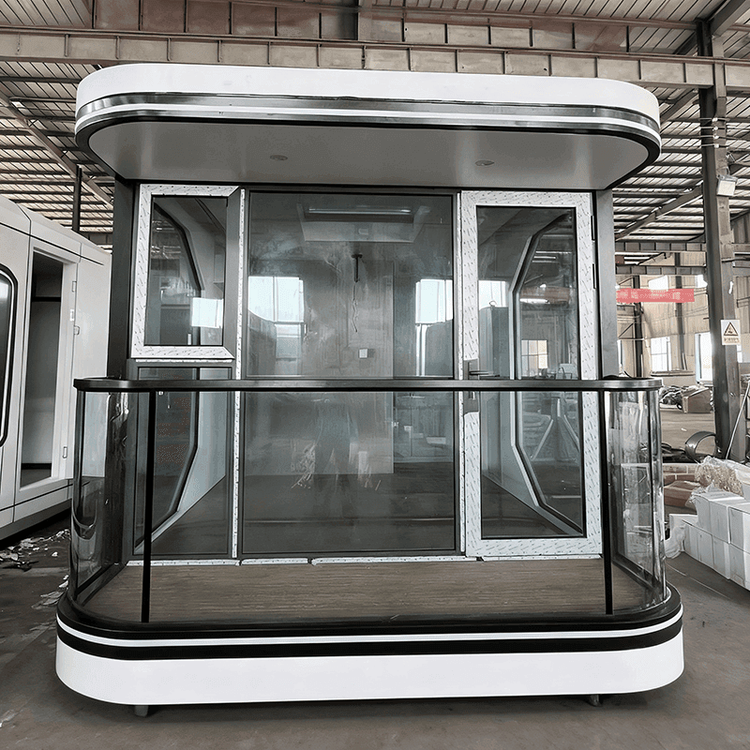
Design Concept of Mobile Toilets
The design concept of mobile toilets centers on resource optimization, environmental adaptability, and sustainable development, achieving functional upgrades through technological innovation.

1. Based on the Demand for Urban Resource Redistribution
Traditional fixed public toilets are constrained by land planning and struggle to meet the instantaneous demands of densely populated areas or temporary events. Mobile toilets employ a modular design, transforming sanitation facilities into flexible units that can be dynamically allocated to optimize urban space utilization and achieve efficient resource distribution. For example, at large events or disaster sites, mobile toilets can be rapidly deployed to alleviate local shortages of sanitation facilities.
2. Reconstruction of Material Circulation Pathways
Mobile toilets break away from traditional linear processing models and establish a circular metabolic system. At the input end, separation collection devices physically separate urine from solid waste: solid excreta is transported via vacuum negative pressure pipes to a pretreatment unit, while urine enters an independent treatment process. The treatment phase relies on microbial technology to decompose solid organic matter into humus, with urine processed to release nitrogen gas. The output end offers diversified resources: solid products can be used as soil conditioners, clarified liquid from treatment can be used for non-contact flushing or green irrigation, and gases are converted to support the system's own operation, forming a closed-loop ecosystem.
3. Environmental Adaptability
Mobile toilets reduce reliance on external infrastructure and enhance environmental adaptability through technological integration. For instance, membrane filtration technology increases the recycling rate of flushing water to more than three times that of traditional systems; phase change material walls use phase change energy storage principles to regulate internal temperature fluctuations more effectively than conventional building materials. These technologies, derived from closed environment maintenance technologies in aerospace and oceanic fields and adapted for civilian use, significantly enhance the applicability of mobile toilets in extreme environments.
4. Sustainable Development Resource Management
Mobile toilets treat feces as convertible resources, transforming them into high-efficiency organic fertilizers through biological treatment technologies. This process not only reduces pollution emissions but also creates added value, driving the transition of public toilets from 'consumption-based facilities' to 'resource circulation nodes', aligning with sustainable development principles.
5. Future Evolution Directions
At the technological level, biochemical treatments (such as microbial fuel cells) are being explored to directly convert organic waste into electricity; at the intelligent level, embedded IoT modules enable functions like usage frequency monitoring and consumable stock alerts; at the functional level, some designs integrate additional features like emergency lighting and information displays, evolving towards a composite direction. These trends indicate that mobile toilets are upgrading from single sanitation facilities to multifunctional, intelligent, and ecological urban service terminals.