
Mobile Toilet Application in Construction Sites
Mobile toilets are widely used in construction sites, providing toilet services for workers. The following is an introduction from the aspects of composition, fabrication, classification, and design principles:
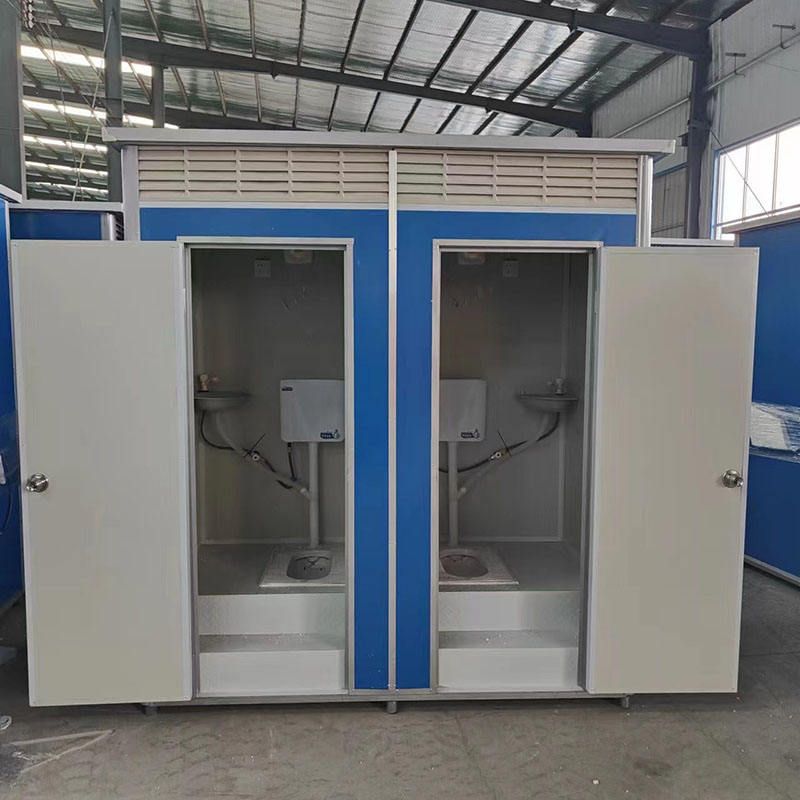
Composition
Mobile toilets generally consist of fecal sewage storage tanks (or fecal sewage treatment devices), floor slabs, sanitary ware, walls, washing equipment, water tanks, roofs, and mobile devices. These components work together to form a complete toilet space, meeting the basic needs of workers on construction sites.
Fabrication
A young man used a water storage tank and a pallet to fabricate a mobile toilet. The specific process is as follows: First, use tools to fix universal wheels at the four corners of the bottom of the pallet to facilitate movement. Then, place the water storage tank retrieved from a garbage station on the pallet and use an angle grinder to cut along the marked line on the top of the tank to form an open tank. Next, invert another open-top water storage tank and stack it on the first tank, securing the outer frame with self-tapping screws. Then, cut out a rectangular opening to form the door. Drill a hole in the floor inside the tank, insert an elbow, connect it to a water pipe, and seal it, then install a toilet. Fix the water pipe on the wall with clips, install a faucet and a pipe cap, connect the water pipe, and then install a stainless steel basin as a washbasin. Connect the water inlet pipe of the toilet tank and the shower hose, install the shower bracket, toilet seat, and spray-type showerhead. Finally, make the toilet door with wooden boards and hinges and install a door handle.
Classification
- By structural form: They can be divided into single-structure mobile toilets and composite-structure mobile toilets. The single-structure type is relatively simple and independent, while the composite-structure type may be composed of multiple parts and may have richer functions.
- By mobility method: They are classified into lifting and handling-type mobile toilets and powered and towed-type mobile toilets. Lifting and handling-type toilets are suitable for places with relatively open spaces where lifting equipment or manual handling is convenient. Powered and towed-type toilets can be moved by vehicles, offering higher flexibility.
- By sewage treatment method: They are divided into water-flush and waterless suction-type mobile toilets, circulating water-flush mobile toilets, and dry-packing mobile toilets. Different treatment methods are suitable for different environments and needs. For example, water-flush toilets offer an experience closer to traditional toilets but require a certain amount of water resources. Dry-packing toilets do not require water and are suitable for areas with scarce water resources.
Design Principles
The design should follow the principles of mobility convenience, economic durability, environmental protection, ecological friendliness, efficiency improvement, and humanitarian promotion. The overall structure should be lightweight and sturdy, with controlled height and width. The mobile device should be complete and reasonable to ensure that the mobile toilet can be easily moved and used on construction sites and other locations while meeting environmental protection and practical requirements.



