Mobile Toilet Broken Handling
If the mobile toilet is broken, follow these steps for handling:

1. Record and Collect Evidence Immediately take photos or videos of the damaged site, focusing on the damaged parts, extent, and surrounding environment. Retain the condition of the transportation packaging (if applicable). If the packaging is damaged and causes the breakage, file a claim with the logistics company and keep relevant evidence (such as photos of the packaging and logistics documents).
2. Stop Operation and Evaluate Once a damaged part is discovered, immediately stop pulling or installing work to prevent further damage. Conduct a detailed inspection of the damaged part:
- If it is a minor crack, looseness, or local wear, attempt to repair it (such as using glue to fix the crack or tightening the screws).
- If it is a severe fracture, deformation, or complete loss of function (such as the door lock not opening or closing, continuous leakage from the water tank), the part needs to be replaced.
3. Contact the Supplier or Installation Team Promptly contact the supplier of the mobile toilet or a professional installation team, explain the damage situation (such as the part name, damaged location, and extent), and request repair or replacement services. If they cannot arrive on-site in a timely manner, inquire about temporary solutions (such as using tape to temporarily fix the door lock or closing the water tank valve to stop the leak), or take temporary measures as guided.
4. Handle Common Damaged Parts Specifically
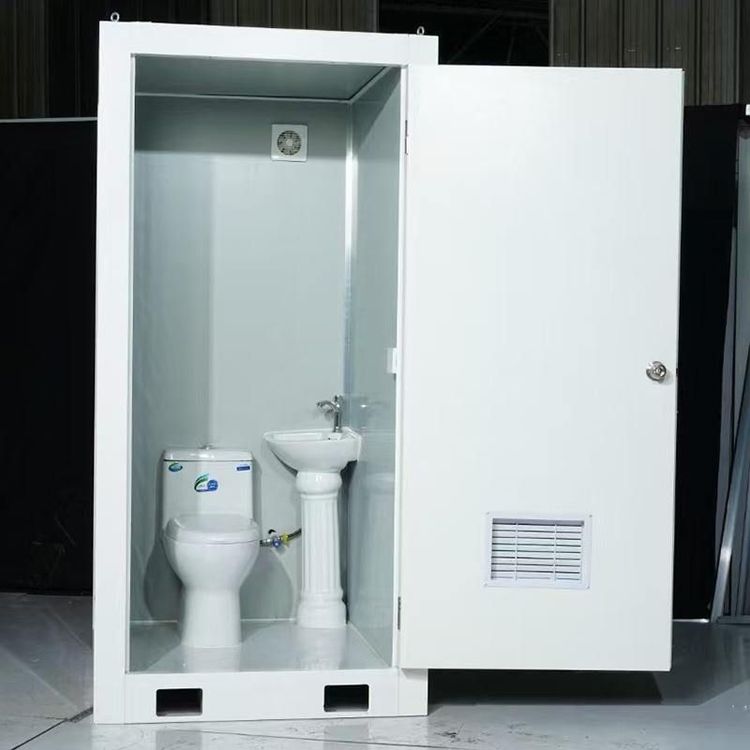
- Door Lock Damage: If the lock core is stuck, spray lubricating oil into the lock hole and repeatedly open and close it to try. If the lock core is broken or the frame is deformed, replace the entire door lock assembly.
- Seat Ring Damage: If there are cracks or breaks, replace it with a new seat ring, ensuring to choose the size and material that match the original model.
- Water Tank or Water Pipe Damage: For water tank leakage, check whether the internal float ball and sealing ring are aged, and replace the damaged parts. For a broken water pipe, cut off the damaged section and replace it with a new one, ensuring that the connection is sealed with Teflon tape.
- Toilet Bowl Damage: If there are cracks or breaks, replace it with the same type of toilet bowl. When installing, seal the edges with waterproof glue to prevent leakage.
- Electrical Component Damage: For lighting or ventilation failures, first cut off the power supply, check whether the circuit connections are loose or burned, and when replacing bulbs, motors, and other components, pay attention to preventing electric shock (such as wearing insulating gloves).
5. Repair or Replace Parts Operate according to the supplier's guidance:
- Use special tools and materials (such as waterproof glue and sealing rings) for repairs.
- When replacing parts, ensure that the model matches. After installation, test whether the functions (such as flushing, locking, and lighting) are normal.
6. Continue Use or Installation After confirming that the parts are repaired or replaced, if the damage occurred during installation, continue to complete the remaining steps and check the overall stability. If the damage occurred during use, test all functions before resuming normal use to ensure there is no leakage, looseness, or abnormal noise. Follow the instructions during operation to avoid violent pulling or overloading.