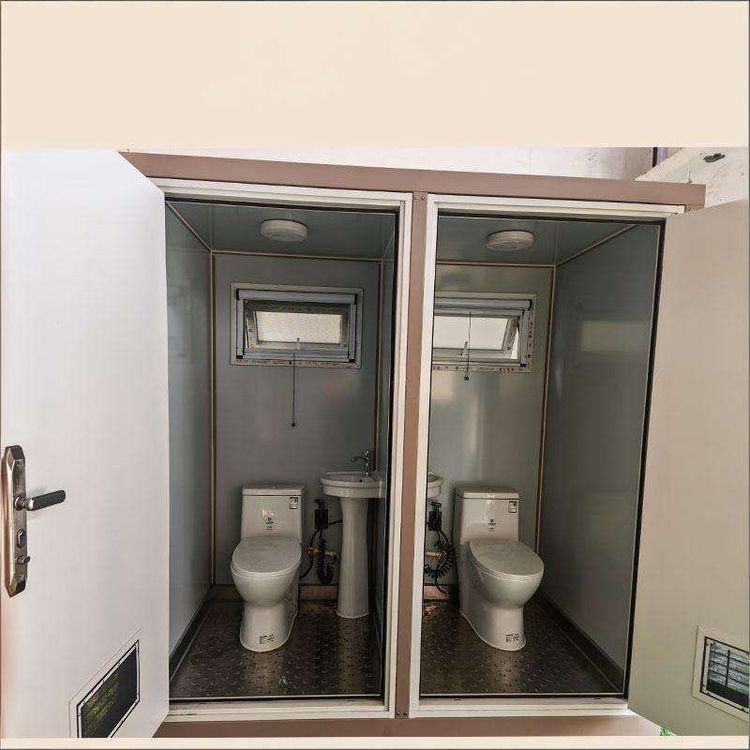
Mobile Toilet Blow-Molded Roof Panel
The blow-molded roof panel of a mobile toilet is typically made of high-density polyethylene (PE) material through blow molding, and its characteristics are similar to those of the main structure of the mobile toilet, but further analysis is required based on the functional requirements of the roof panel.

1. Material and Process Basics
The main body of a mobile toilet is produced with a hollow structure using high-density polyethylene (PE) through blow molding. This process involves injecting molten plastic into a mold under high pressure to form a thin-walled hollow structure. PE material is lightweight, low-cost, and easy to process, while blow molding can efficiently produce thin-walled components with complex shapes, making it suitable for structures like roof panels that need to balance strength and weight. Although the reference information does not directly mention the roof panel, as the top covering of the mobile toilet, it is highly likely that the roof panel uses the same material as the main body to achieve process uniformity and cost optimization.
2. High-Temperature Resistance Analysis
The long-term service temperature of PE material can reach 80℃, and it can withstand higher temperatures in the short term. However, the high-temperature resistance requirements of the mobile toilet roof panel need to be considered in conjunction with the actual scenario. If the roof panel is directly exposed to sunlight or high-temperature environments, relying solely on the heat resistance of PE may not be sufficient, and structural optimization (such as adding thermal insulation layers or reflective coatings) is required to enhance high-temperature resistance. For example, adding thermal insulation foam to the inner layer of the roof panel or applying reflective paint to the outer layer can reduce heat transfer and prevent the internal temperature from becoming too high, affecting user comfort.
3. Corrosion Resistance Analysis
The chemical inertness of PE enables it to resist common corrosive liquids such as urine and disinfectants, which is the basis for the corrosion resistance of the mobile toilet roof panel. The dense surface formed by blow molding further enhances the anti-permeability ability, reducing the erosion of the material by corrosive substances. In addition, the roof panel is usually designed to avoid water accumulation, with slopes or drainage channels to guide the liquid away, further reducing the risk of corrosion. If the roof panel needs to be in long-term contact with strong acids or alkalis, more corrosion-resistant materials (such as polypropylene or specially modified PE) may be required, but PE is sufficient for conventional scenarios.
4. Structural Optimization and Functional Adaptation
As the top structure of the mobile toilet, the roof panel needs to meet requirements such as waterproofing, load-bearing, and ventilation. Blow molding can produce hollow roof panels with reinforcing ribs, enhancing structural strength through internal ribs while maintaining light weight. For example, designing cross-ribs in the inner layer of the roof panel can not only disperse the impact force of rainwater but also withstand slight snow accumulation or personnel stepping. In addition, the edge of the roof panel can be designed with a sealing structure to connect tightly with the main body of the toilet, preventing rainwater leakage.
5. Limitation Explanation
The reference information does not clarify whether the roof panel completely adopts the same process and material as the main body. In actual design, the formula or process parameters may be adjusted according to functional requirements. For example, to improve the UV resistance of the roof panel, UV stabilizers may be added; to enhance fire resistance, flame retardants may be added. These improvements need to be carried out on the premise of ensuring the feasibility of the blow molding process to avoid affecting production efficiency or cost.