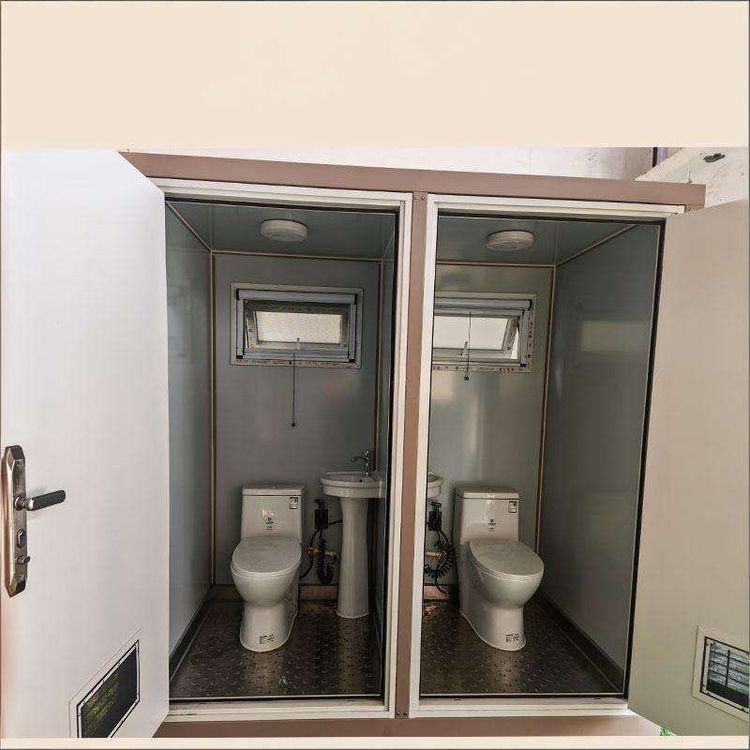
Mobile Public Toilet & Environmental Toilet
Mobile public toilets (environmental toilets) are facilities that can be moved as a whole and provide toilet services to the public, featuring environmental protection, flexibility, and durability.

Technical Features and Design
Mobile public toilets are designed based on new materials and water-saving technologies. They employ a method of automatically collecting hand-washing water and adding special agents to achieve a flushing effect with only 0.46 liters of water per person, significantly reducing water consumption. Their frames are mostly welded from national standard steel, with surfaces covered with anti-corrosion and fire-resistant materials such as color-coated steel plates or carved panels, ensuring a service life of over 20 years. Internally, they are equipped with an independent toilet pit partitioned treatment system: the urine channel utilizes gravity flow, while the feces channel is cleaned by a piston-type scraper mechanical device. They are also equipped with non-slip floors, automatic flushing toilet bowls, and ventilation and lighting systems, complying with the GBLT18091-92 standard to ensure safety and hygiene in use.
Classification and Functional Expansion
Mobile public toilets can be classified by structural form into single-unit structures and composite structures; by mobility into hoisting and handling types and powered and towed types; and by sewage treatment methods into water-flush and waterless-flush suction types, circulating water-flush types, and dry-packing types. Since 2012, the technological routes have gradually improved, forming types such as waterless-flush, foam-sealing, and water-flush types, and covering细分品类 (sub-categories) such as antique-style, temporary construction site, and marine types, supporting vehicle-mounted and traditional public toilet renovations. The product forms have expanded to trailer-type, box-type substation cabinet-type, and stainless steel sentry box-type, adapting to diverse scenario demands.
Application Scenarios and Advantages
Mobile public toilets have been widely applied in public places such as scenic spots, service areas, and rural areas, with their core advantages being mobility, combinability, and ease of transportation. For example, during the May Day holiday in 2026, the Jinci Scenic Spot in Shanxi flexibly deployed buses as mobile men's toilets and temporarily converted fixed men's toilets into women's toilets, increasing the average daily reception capacity from about 3,000 to around 5,000 people, effectively alleviating peak passenger flow pressure. Additionally, mobile public toilets reduce resource waste caused by the demolition of fixed facilities and adapt to changing site requirements, making them an efficient solution in public facility planning.