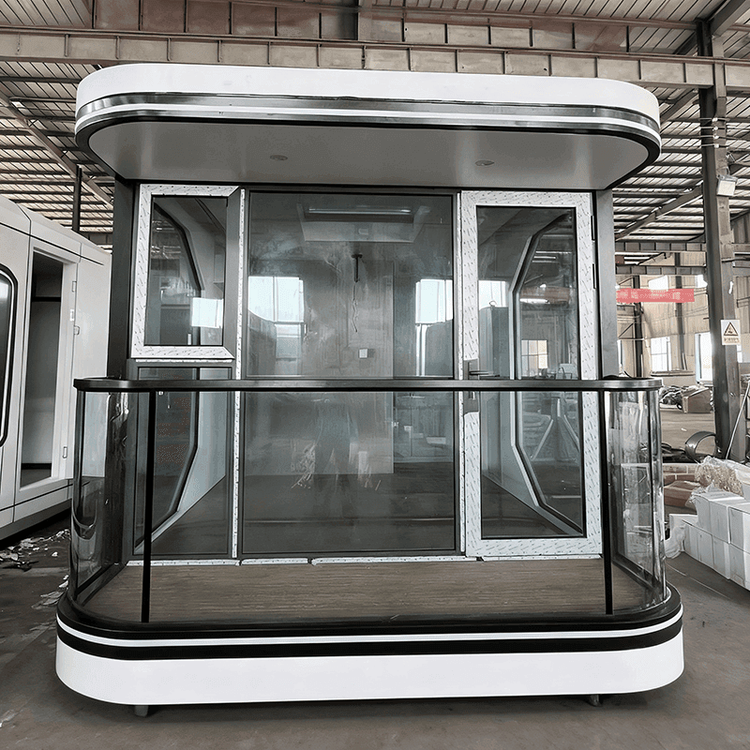
Mobile Public Toilet
A mobile public toilet is a facility that can be moved as a whole and provides toilet services to the public.

Suitable Locations
Mobile public toilets are suitable for a variety of locations, including transportation hubs such as train stations and docks, facilitating travelers in addressing their toilet needs during their journeys. They can meet the demands of a large number of tourists at tourist attractions, enhancing the tourism experience. They also provide convenience for residents in villa areas and newly built residential communities. On large construction sites, they solve the toilet problems for workers. In public squares, densely populated public areas, and bustling commercial streets with high foot traffic, they effectively alleviate the shortage of public toilet resources.
Composition Structure
Generally, they are composed of fecal sewage storage tanks (or fecal sewage treatment devices), floor slabs, sanitary ware, walls, washing equipment, water tanks, roofs, and mobile devices. These components work together to achieve the basic functions of mobile public toilets. For example, the fecal sewage storage tank is used to collect and store fecal sewage, the sanitary ware provides a clean toilet environment for users, and the mobile device ensures the mobility of the toilet.
Material Development
Initially, mobile public toilets were made of wood, but their structure and functions were simple, and they easily absorbed odors. With technological progress, materials such as fiberglass and polyethylene have gradually been adopted. These new materials offer better performance. For instance, fiberglass is lightweight yet hard and corrosion-resistant, while polyethylene has good chemical stability and electrical insulation, effectively improving the quality and service life of mobile public toilets.
Classification Methods
They can be classified by structural form into single-structure mobile toilets and composite-structure mobile toilets; by mobility into hoisting and handling mobile toilets, powered and towed mobile toilets; and by sewage treatment method into water-flush and non-water-flush suction mobile toilets, circulating water-flush mobile toilets, and dry-packing mobile toilets. Different types of mobile public toilets are suitable for different scenarios and needs.
Advantages
They have the advantages of mobility, combinability, and ease of transportation. They can be conveniently transported to any location where toilets need to be installed and can be used repeatedly. For example, small and intelligent eco-friendly mobile toilets are fully equipped with internal fecal collection systems, handwashing sinks, smart mirrors, and breathing lights. They are manufactured as a whole in the factory and can be used immediately upon purchase. Towable mobile eco-friendly smart toilets can be moved around at any time and place.