
Mobile Portable Toilet
A mobile portable toilet, also known as a mobile toilet, is a facility that can be moved as a whole to provide public toilet services.
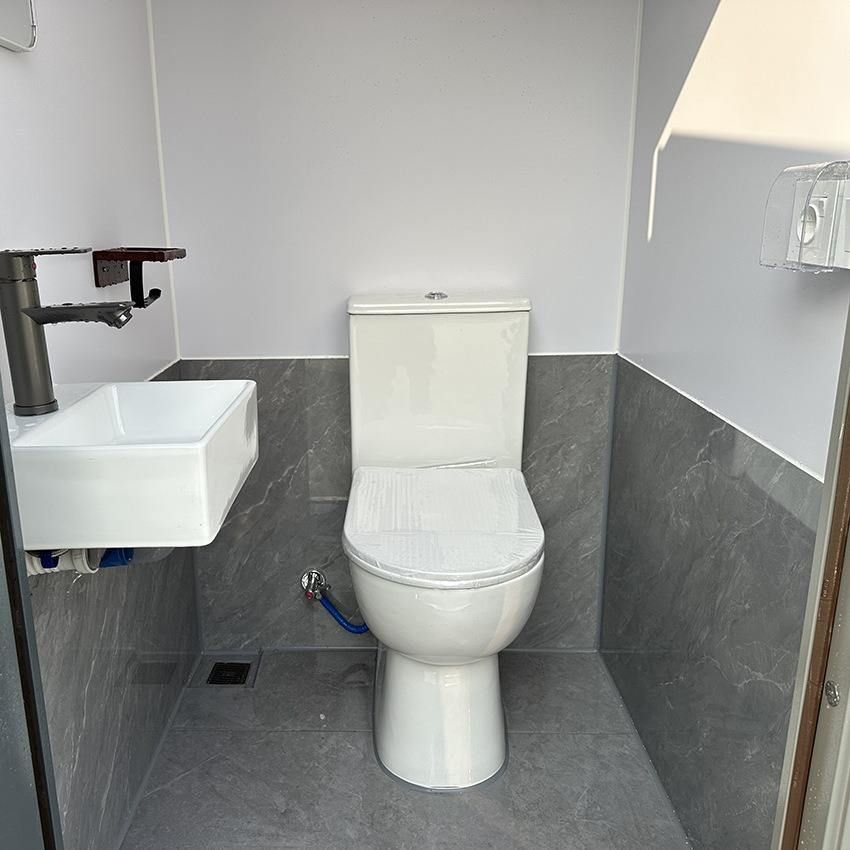
I. Basic Components A mobile portable toilet typically consists of core components such as a fecal sewage storage tank (or disposal unit), flooring, sanitary ware, walls, washing equipment, a water tank, a roof, and a mobile unit. Some simplified versions may streamline the structure, for example, using a water storage bucket or tank as the water source, achieving mobility through universal wheels fixed on a pallet, and installing basic equipment such as a toilet, faucet, and washbasin to form a low-cost and easy-to-operate solution.
II. Classification Methods
- By structural form: They are divided into single-unit structures (independent units) and composite structures (multi-unit combinations). The former is suitable for space-constrained scenarios, while the latter can expand service capacity.
- By mobility method: They include lifting/handling types (requiring mechanical assistance) and powered/trailer types (with built-in power or connectable to vehicle traction). The choice depends on the transportation convenience of the usage scenario.
- By sewage treatment method:
- Water-flush and waterless-flush suction types: They rely on a water source for flushing, and the sewage needs to be periodically pumped out; the waterless-flush type reduces odors through chemical agents or vacuum suction.
- Recirculating water-flush type: Equipped with a water treatment system, it achieves sewage purification and reuse, suitable for long-term fixed use.
- Dry-packing type: It uses biodegradable bags to collect feces, requiring no water source, and is suitable for water-scarce areas or regions with high environmental protection requirements.
III. Core Advantages
- Mobility: Through modular design, it can be quickly deployed to temporary events, disaster relief areas, or remote regions to meet short-term toilet needs.
- Combinability: Multi-unit拼接 (splicing) can expand service scale to adapt to scenarios with different population densities.
- Reusability: The structure is durable and can continue to serve after maintenance, reducing long-term costs.
- Environmental adaptability: The dry-packing or recirculating water-flush types reduce water consumption, aligning with sustainable development concepts.
IV. Application Scenarios They are commonly seen in large-scale outdoor events (music festivals, sports events), construction sites, tourist attractions, emergency rescue scenarios, etc. Some households or small commercial establishments may also adopt simplified homemade versions to meet flexible needs. Their design balances functionality and economy, making them indispensable sanitary facilities in modern cities and temporary scenarios.



