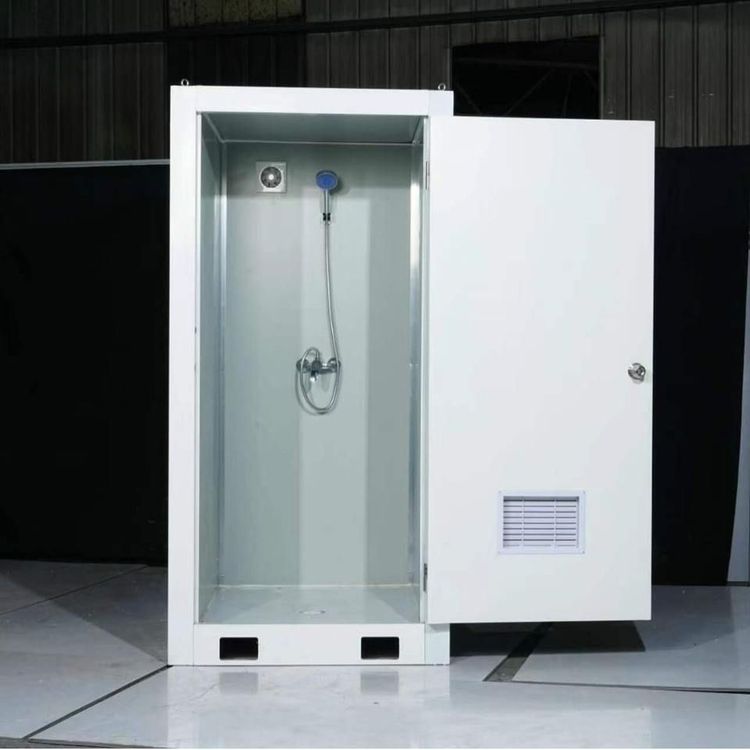
Mobile Holiday House Toilet
There is currently no unified standard configuration for mobile holiday house toilets, but reference can be made to the general design of mobile toilets and combined with the needs of holiday houses for planning. Mobile toilets are designed as movable facilities to meet the toilet needs of temporary or fixed locations. They feature diverse structures, mobility methods, and sewage treatment approaches, and the design ideas in cultural and tourism scenarios can provide references for mobile holiday house toilets.

Mobile toilets are typically composed of core components such as fecal sewage storage tanks (or disposal devices), floor slabs, sanitary ware, walls, washing equipment, water tanks, roofs, and mobility devices. The combination of these components determines the functions and applicable scenarios of the toilets. For example, in densely populated areas like train stations and docks, mobile toilets need to have the characteristics of rapid deployment and large-capacity storage; while in tourist attractions or villa areas, more attention is paid to environmental harmony and user comfort.
In terms of structural form, mobile toilets can be divided into single-unit structures and composite structures. Single-unit structures are suitable for scenarios with limited space or requiring flexible layout, such as small holiday houses; composite structures achieve functional expansion through modular design and are suitable for large holiday houses or clustered resort areas. Regarding mobility, lifting and handling types are suitable for short-distance movement, while powered and towed types support long-distance transportation. Holiday house toilets can be selected according to actual needs.
Sewage treatment methods are crucial in the design of mobile toilets. Water-flush types require supporting water sources and sewage pipelines and are suitable for holiday houses with infrastructure support; non-water-flush suction types achieve environmental protection through regular cleaning of storage tanks and are suitable for remote areas; circulating water-flush types reuse water resources through filtration systems and are suitable for scenarios with water shortages; dry-pack types are completely water-free and encapsulate feces with biodegradable materials, suitable for extreme environments or temporary use.
In cultural and tourism projects, mobile toilets often adopt thickened galvanized square tube welding structures to enhance durability or use thermal-insulated metal carved panel exterior walls to adapt to climate differences. In terms of internal configuration, facilities such as four squatting positions, urinals, and column basins can meet basic needs, while upgraded configurations like smart sensor flushing and ventilation systems can enhance the user experience. The specific configuration of mobile holiday house toilets needs to be further optimized based on the scale, usage frequency, and user groups of the holiday houses.