
Mobile Fixed Toilet
A mobile toilet is a facility that can be moved as a whole and provides toilet services to the public, with advantages such as mobility, modularity, and ease of transportation.
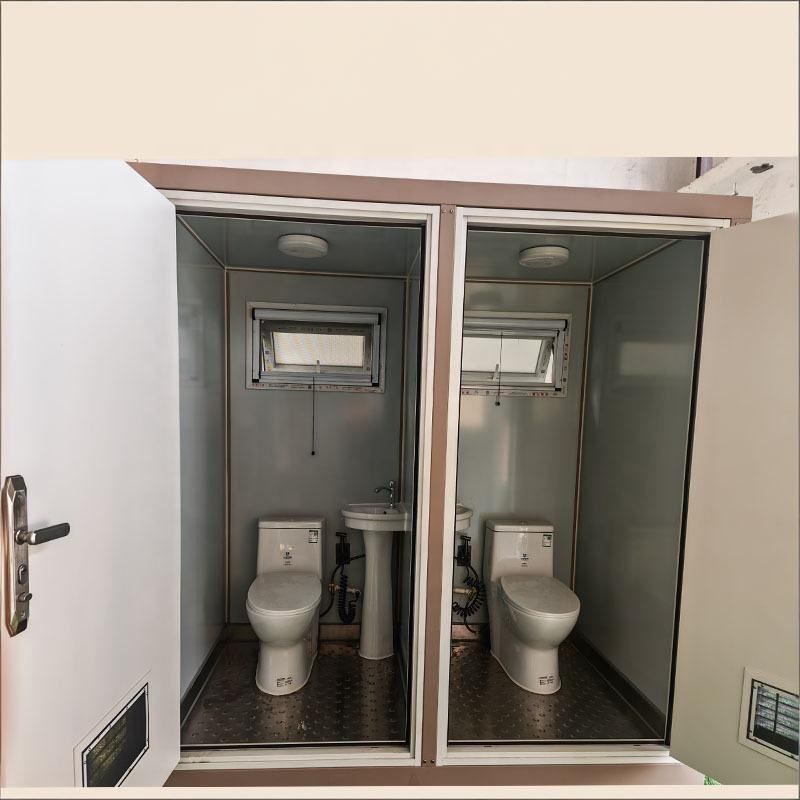
I. Basic Components A mobile toilet generally consists of a fecal sewage storage tank (or fecal sewage treatment device), flooring, sanitary ware, walls, washing equipment, a water tank, a roof, and a mobile device. Among them, the fecal sewage storage tank is used to collect and temporarily store excreta, and some types are equipped with treatment devices for preliminary processing. Sanitary ware includes toilets or squat pans to meet basic toilet needs. The walls and roof form an enclosed space to ensure the privacy and safety of users. The water tank provides flushing water for water-flush toilets, while the washing equipment facilitates user cleaning. The mobile device is the core component that enables the toilet to be moved as a whole.
II. Classification Methods
- By structural form: Mobile toilets are divided into single-structure mobile toilets and composite-structure mobile toilets. Single-structure toilets are relatively simple and suitable for places with limited space or small temporary needs. Composite-structure toilets are composed of multiple single units and have more complete functions, meeting the needs of large crowds or diverse requirements.
- By mobility method: This includes lifting and handling mobile toilets, which are usually small in size and light in weight and can be moved by cranes or manual handling. Powered and towed mobile toilets are equipped with power systems or towing devices and can be quickly transferred by vehicle traction, suitable for scenarios requiring frequent movement or long-distance transportation.
- By sewage treatment method: Water-flush and non-water-flush suction mobile toilets treat excreta through water flushing or suction. Recirculating water-flush mobile toilets recycle treated water to save water resources. Dry-packing mobile toilets use biodegradable packaging bags to collect excreta without the need for water, suitable for water-scarce areas or places with high environmental protection requirements.
III. Core Advantages Mobile toilets can be conveniently transported to any location where they are needed, such as large event sites, construction sites, and tourist attractions, and can be used repeatedly according to demand. Their mobility avoids the limitations of traditional fixed toilet construction. Their modularity allows for flexible adjustment of the number and scale of toilets according to actual foot traffic. The ease of transportation further reduces deployment and recovery costs.



