Mobile Environmental Toilet Design
Mobile environmental toilet design encompasses various types and technological approaches, covering material innovation, water-saving techniques, and diverse product forms, suitable for different scenarios.
I. Standardized Design Based on New Materials and Water-Saving Technologies
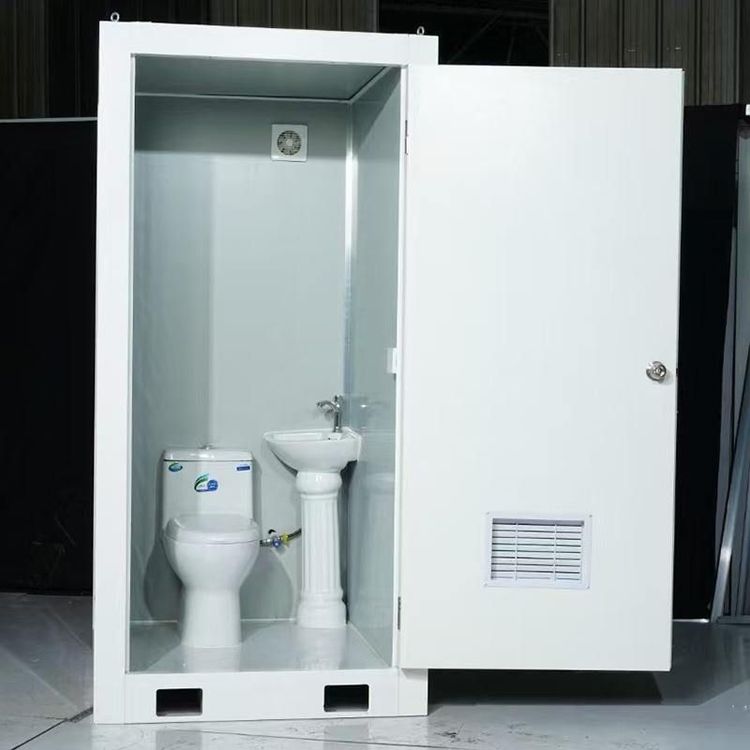
This design focuses on efficient water conservation, employing technology that automatically collects hand-washing water and adds specialized agents, achieving a flushing effect with only 0.46 liters of water per person, significantly reducing water consumption. Its structural framework is welded from national standard steel, with surfaces covered in corrosion-resistant and fireproof materials like color-coated steel sheets or carved panels, ensuring a service life of over 20 years. Internally, it features an independent urinal and toilet partitioned treatment system: the urinal channel utilizes gravity-flow design to minimize mechanical failure risks; the toilet channel employs a piston-type scraper mechanism for cleaning, avoiding blockages that traditional flushing might cause. Additionally, it is equipped with anti-slip flooring, automatic flushing toilets, and ventilation and lighting systems, complying with the GBLT18091-92 standard, suitable for public places like scenic spots and service areas.
II. Handmade DIY Design for Portable Restrooms
For temporary or low-cost needs, there are design solutions involving handmade modifications using materials like water storage buckets or tanks. For instance, a water storage bucket can be split in half, with caster wheels fixed to a wooden base for mobility, height increased with wooden strips, and side openings fitted with door frames, walls, and roofs. Internally, it can be equipped with drain pipes, toilets, bath heaters, and sinks to meet basic usage requirements. Another option combines a water storage tank with a pallet, with caster wheels installed at the bottom of the pallet to form a simple portable structure. These designs offer high flexibility but require attention to material durability and sealing, suitable for rural areas or construction sites.
III. Diversified Development of Technological Routes and Product Forms
Since 2012, the technological routes for mobile public toilets have gradually matured, forming three mainstream directions: waterless flushing, foam sealing, and water flushing, and covering细分品类 (sub-categories) like antique-style, temporary construction site, and marine-use types. Product forms have expanded to include trailer-mounted, box-type transformer cabinet-style, and stainless steel kiosk-style options, supporting vehicle-mounted mobility or traditional public toilet renovations. For example, trailer-mounted public toilets can be quickly deployed via vehicle towing, suitable for emergency scenarios; box-type transformer cabinet-style toilets utilize repurposed old cabinets, reducing costs while achieving resource reuse. Application scenarios now cover public areas like scenic spots, service areas, and rural regions, meeting sanitation needs in various environments.
The design of mobile environmental toilets achieves a balance between functionality and environmental protection through material innovation, water-saving technologies, and form optimization, providing flexible and efficient solutions for public facility construction.