
MiC Modular Integrated Construction: An Advanced Prefabricated Building Product
Standardized dimensions, modular components, simpler construction... Riding national policy and technology innovation, the prefabricated building industry has entered a golden growth period. The idea that "building a house can be as simple as stacking blocks" is becoming familiar to more people.
1. What MiC Means
Modular Integrated Construction (Modular Integrated Construction, or MiC), also called "assembly synthesis construction," means that at the scheme or construction-drawing stage, a building is divided into modules by function. Those modules are then industrially prefabricated to high standards and high efficiency (including finishes, hardware and sanitary fittings, equipment installation, and more), and finally delivered to the site and assembled into a complete building.

(Case: Avenue South Residences in Singapore—the world's tallest prefabricated modular residential towers. Two 56-story towers are planned for completion in 2026, "set beside one of Singapore's greenest avenues, surrounded by five conserved historic buildings.")
2. Technical Features
The difference between MiC modular integrated construction and traditional building can be summed up as "four raises, four lowers." The four raises are higher building quality, higher construction efficiency, higher building integration, and higher technology content. The four lowers are lower labor demand, fewer quality risks, lower safety risks, and less pollution and waste.
MiC achieves standardized design, factory production, assembled construction, integrated fit-out, and digital management—"five integrations in one." It fundamentally overcomes weaknesses of traditional methods, reduces common building defects, breaks the silos of design, production, construction, and fit-out, and enables highly specialized collaboration across the building value chain—driving the industry toward refined, industrialized, low-carbon, and digital transformation at every stage of delivery.

(Case: Learning House Munich—an intelligent modular building with mature construction technology. Each module contains four teaching spaces; two rooms connect to support full-day care and staff work areas. Each room has a direct outdoor walkway, creating free learning space while meeting fire-safety codes.)
3. Applications
Guided by the dual goals of peaking carbon emissions by 2030 and carbon neutrality by 2060, and by guidance on coordinated smart construction and building industrialization, modular integrated construction has won growing market attention and recognition.
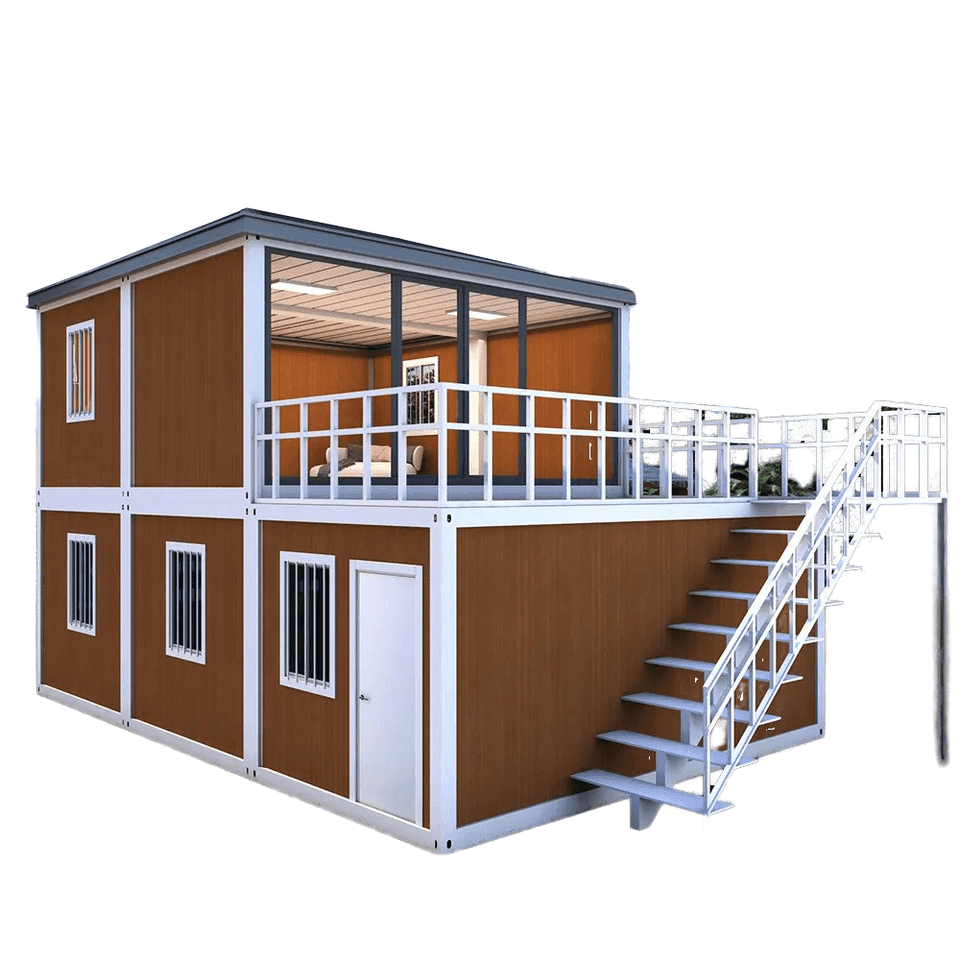
Modular integrated construction points to the next wave of technology and industry change in building. In the sector it is also known as prefabricated modular box housing—box buildings or container houses: a structure in which each room is a prefabricated unit, with exterior wall panels and interior fit-out completed in the factory before on-site installation. Modular technology sits at the frontier of building industrialization, and MiC has a wide range of uses. Today it is widely applied to schools, quarantine centers, negative-pressure hospitals, and temporary buildings, and can also serve science museums, museums, exhibition halls, showrooms, and similar projects.

(Case: Qatar 2022 FIFA World Cup venue. The stadium was broken into many modules made from adapted shipping containers, echoing the nearby port. Containers were converted into stadium infrastructure including stairs, concessions, and bathrooms.)
4. Technical Advantages
MiC splits a building into three-dimensional spatial units. Finishes, plumbing, HVAC, and M&E for each unit are completed once in the factory; on site, units are simply stacked like building blocks to finish the project. This aligns with green construction: material waste falls by about 25%, construction waste by about 70%, and energy use by about 55%, while site noise and dust drop sharply—clear green and energy-saving gains. It also supports carbon neutrality and peaking goals. With demountable, reusable product traits, some temporary MiC components reach secondary reuse rates above 90%, cutting material waste and speeding land reuse.

"Speed" is one of MiC's clearest advantages—and clear versus other prefabricated assembly modes. From projects of a few thousand USD up to tens of thousands of square meters, delivery in 30–60 days is a pace traditional construction cannot match, and that even other prefabricated methods struggle to reach.
Beyond speed, high quality is another major MiC strength.
With strong policy support, domestic prefabricated building continues to accelerate. Prefabricated components are still the main form. From 1.0-era traditional components to 4.0-era MiC—from temporary to permanent buildings, from low-rise to multi-story—MiC has lifted prefabricated technology in a leap and can be called a breakthrough product among assembly methods.
Versus prefabricated components, MiC advantages stand out as:
Higher assembly rate. Each MiC module is an independent structure with most M&E, drainage, and fit-out already done; assembly rates can exceed 90%, far above typical prefabricated components.
Better quality control. Factory production can reach millimeter-level building precision.
Greener, shorter schedules, and less labor on site.

(Case: Jiangxinzhou temporary resettlement school. The project uses a container assembled structural system plus standardized container components and a factory-made custom wayfinding system, creating a strong sense of place with a weaker "temporary" feel. A "ji"-shaped courtyard adds spatial layers and a richer skyline; the custom signage system leads standardized units—so a temporary school does not feel temporary.)
5. Marketization of MiC Products
According to Ministry of Housing and Urban-Rural Development materials, during the 13th Five-Year Plan period cumulative domestic prefabricated building area reached 222,222,222 m2, with average annual growth of 54%. The ministry set a 2025 target for prefabricated buildings to account for 30% of new construction, up from 15% in 2020—implying, if new-build area stays flat, a compound annual growth rate of about 14.9% for prefabricated floor area from 2021 to 2025. By market size, estimates reach about USD $30 billion. In a trillion-yuan-scale prefabricated market, MiC products, with clear competitive advantages, are expected to gain share quickly.

(Case: Yuyao North Zhong'ang Xiangyunfu modular sales office—floor area 619 m2, 60% factory prefabrication, modular interior fit-out)
In 2021, our company's modular projects in Shenyang, Xining, Tianjin, Chuzhou, Shanghai, Chongqing, Suzhou, and other cities marked an important strategic step toward nationwide development. Faster MiC penetration in the national prefabricated market rests not only on the product itself, but also on capacity layout and MiC product diversification as key support.

(Case: supporting temporary buildings for Kunshan Modern Sci-Tech Agriculture Industrial Park—our company Cultural Development Co., Ltd.)
6. Technology Empowering MiC Growth
As an advanced product of prefabricated building, MiC concentrates our company's industrial production and digital capabilities. Its foundation is an industry-leading smart construction system—from prefabricated BIM design to MES data processing to MiC automated production lines. Built on R&D and experience, that system keeps production efficiency and product quality at the industry forefront.
Under the dual-carbon strategy, China's prefabricated building market is booming. As a breakthrough assembly method, MiC delivers higher assembly rates and "faster, better" building products—and is set to hold an important place in prefabricated development.
More fundamentally, technology strength represented by MiC is playing an ever greater role in our company's growth.
Website: www.ourcompany.com
Phone: 17721310336
Email: marketing@ourcompany.com
24H premium service hotline: 400-716-6557
Address: 2177 Shenkuun Road, Minhang District, Shanghai




