Dimensions of Environmental Protection Mobile Toilets in Lvliang
The common dimensions of environmental protection mobile toilets in Lvliang vary depending on the type, as detailed below:

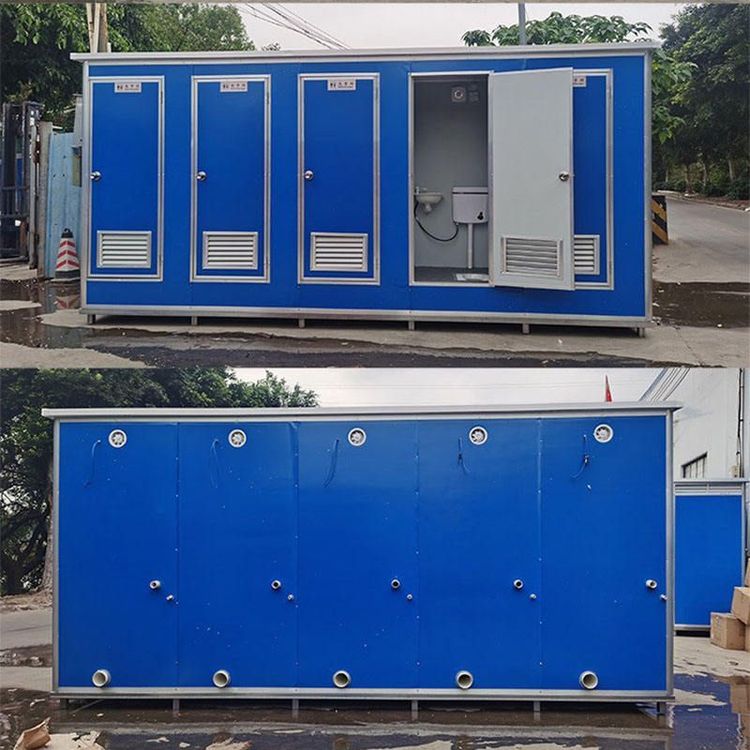
The common basic dimensions of environmental protection mobile toilets in the Lvliang area are 1.1m×1.1m×2.3m (length, width, height). This specification is mostly used for single-person basic models, suitable for ordinary public places or temporary event scenarios. Its compact design meets the needs of single-person use while facilitating transportation and installation.
For different usage scenarios, the dimensions of mobile toilets are adjusted accordingly. For example, the length of the double-occupancy model is extended to approximately 2.5m, with the width remaining at 1.1m and the height still at 2.3m. This design accommodates two independent toilet compartments by increasing the length while keeping the width and height unchanged, balancing space utilization and user comfort.
The dimensions of barrier-free mobile toilets must meet the needs of special populations, typically being 1.5m×1.8m×2.4m (length, width, height). Their width and length are significantly increased to provide wheelchair turning space, and the height is slightly raised to accommodate the installation of barrier-free facilities, ensuring safe and convenient use by individuals with mobility impairments.
Additionally, the dimensions of small portable folding mobile toilets can be reduced to 1m×1m×2m (length, width, height). These products significantly reduce volume through folding design, facilitating portability and temporary deployment, suitable for scenarios with extremely high space requirements such as outdoor expeditions and emergency rescue.
It should be noted that the dimension design of mobile toilets must comprehensively consider functional requirements, transportation convenience, and the characteristics of the usage scenario. For example, basic and double-occupancy models achieve capacity expansion by adjusting length, barrier-free models meet special needs by expanding planar dimensions, and portable models enhance flexibility by reducing volume. When making an actual selection, it is necessary to comprehensively evaluate factors such as the specific usage scenario, pedestrian traffic density, and budget to ensure the optimal balance between functionality and cost-effectiveness of the mobile toilets.