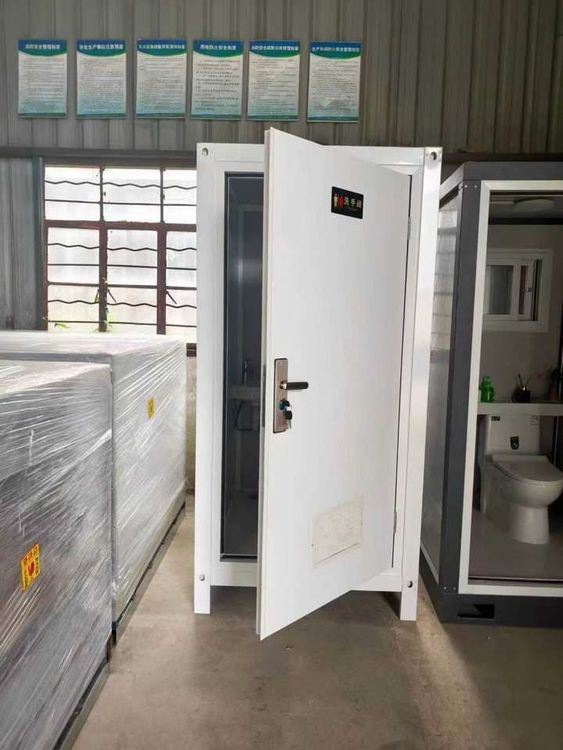
Luxury Mobile Toilet
There is currently no unified standard definition for a 'luxury mobile toilet', but its core features can be summarized by combining the characteristics of mobile toilets and high-end mobile commodes:

1. Structural and Spatial Design: Customization and Spaciousness
Luxury mobile toilets typically feature customized designs. For example, in a case where Dezhou Hongtu Metal Products Co., Ltd. customized a unit for a client in Hunan, the overall dimensions reached 10 meters in length and 3 meters in width, with an L-shaped design that not only met functional requirements but also enhanced visual appeal through its unique appearance. The internal layout prioritizes comfort, potentially including separate compartments, high-end decorative materials like marble countertops, and even integrated amenities such as sinks and mirrors, forming a complete 'mini-bathroom' function.
2. Materials and Craftsmanship: Durability and Aesthetics Combined
The exterior materials are preferably thermal insulation types, such as metal frames paired with composite panels, which adapt to temperature variations in outdoor environments and reduce energy consumption. The interior decor employs materials like marble and non-slip floor tiles that are easy to clean and wear-resistant, enhancing the long-term user experience. The mobile commode part may use stable materials like ABS engineering resin, with some products incorporating antibacterial components to reduce odors and bacterial growth, while further optimizing leak-proof performance through double-layer sealing designs.
3. Functional Configuration: Integration of Intelligence and Humanization
Luxury versions may integrate water flushing systems (such as circulating water flush types) or dry packing technology, balancing environmental protection and convenience. The mobile commode part emphasizes stability and safety, for instance, adopting barrel-type or thick-leg structures with a stated load-bearing capacity of up to 200 kilograms, and featuring conical designs with anti-slip pads to prevent tipping. Additionally, auxiliary facilities like handrails and backrests become standard, with some products possibly adding intelligent functions such as warm air drying and automatic flushing to enhance user comfort.
4. Mobility and Installation Methods: Flexibility and Adaptability
Depending on the usage scenario, luxury mobile toilets may adopt lifting, towing, or powered mobility methods for rapid deployment and relocation. For example, powered mobile toilets can autonomously drive to designated locations, while towed types are transported over long distances by vehicles, meeting diverse needs in temporary events, scenic spots, construction sites, etc.
To further clarify the 'luxury' standard, one can refer to the classification dimensions of mobile toilets: They are divided by structural form into single-unit structures (independent units) and composite structures (multi-unit combinations); by sewage treatment methods into water flush, non-water flush suction, circulating water flush, and dry packing types, etc. For mobile commodes, emphasis should be placed on stability, slip resistance, and material safety to ensure reliable user experiences in different scenarios.