
Large Container Renovated House
The renovation of large container houses requires comprehensive consideration of factors such as structural safety, functional layout, thermal performance, environmental protection, and compliance. The following is an analysis from multiple dimensions:
1. Structural Safety and Stability
The core of renovating container houses is to ensure structural safety. Container houses with all-steel structural frames perform excellently in terms of wind and earthquake resistance. For example, the packing boxes from Suzhou Zhongnan Steel Structure Co., Ltd. have a frame deformation rate of only 0.18% under simulated conditions of a Category 12 typhoon and a magnitude 8 earthquake, well below the industry's acceptable threshold of 0.3%. During renovation, the bottom frame needs to be reinforced, such as by adding C-shaped steel purlins to distribute the load and avoid insufficient floor stiffness. At the same time, the surface of the container body should be treated for corrosion resistance, such as by shot blasting for rust removal and then spraying zinc-rich primer and polyurethane topcoat to extend its service life.
2. Functional Layout and Space Utilization
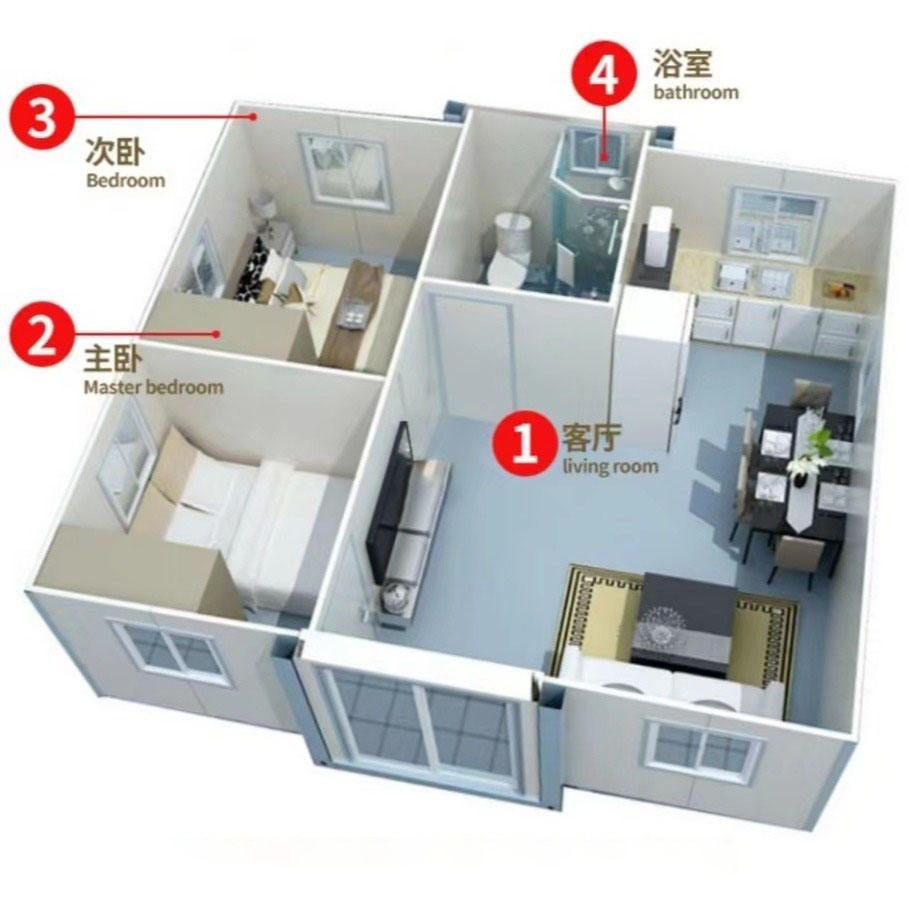
The standard size of container houses (e.g., 3 meters × 6 meters) limits the internal space, so a functional overlay strategy is required to optimize the layout. The kitchen and bathroom can be compressed to one end of the container body to form a wet area, using integrated bathroom technology to achieve waterproof integration. The living and sleeping areas can achieve day-night functional switching through variable furniture, such as wall-mounted folding tables and drop-down beds. In addition, space can be expanded through modular assembly. For example, the fast-assembly boxes from Suzhou Zhongnan support on-demand assembly and can complete the construction of 10 standard dormitories in one day.
3. Thermal Performance and Comfort
Metal container bodies have a high thermal conductivity coefficient, so a multi-layer structure is required to improve thermal performance. The outer layer uses galvanized sheets to resist wind and sand erosion, the middle layer is filled with 80-100 mm thick rock wool as the main insulation layer, and the inner layer uses PVC-coated steel sheets to reduce thermal radiation. Some designs also add an elevated layer at the bottom of the container body to block ground cold bridge conduction. For example, the container houses in the Baotou camp use a broken-bridge lining structure, making the indoor temperature 8-10 degrees Celsius higher than the outside in winter without heating.
4. Environmental Protection and Sustainability
The core value of container houses lies in the full life-cycle recycling of materials. Each standard 20-foot container consumes about 1.2 tons of steel, with a disassembly and assembly loss rate controlled within 5%. Compared with traditional prefabricated houses, the amount of construction waste is reduced by about 90%. In addition, a self-circulating sewage system can be integrated. For example, gray water is used for vegetation irrigation after sedimentation and activated carbon filtration, and black water is converted into liquid fertilizer through fermentation with microbial agents, achieving a water self-sufficiency rate of over 70%.
5. Compliance and Scenario Adaptation
Renovation needs to meet domestic and foreign certification standards, such as the GB50011-2010 Code for Seismic Design of Buildings. Under extreme conditions, it is necessary to prioritize verifying the product's wind and earthquake resistance test reports to avoid using unqualified products. For example, the fan village project for the Qatar World Cup adopted a "factory prefabrication + on-site fast assembly" model, completing the delivery of 1,000 accommodation modules within three months, 40% shorter than the industry average. In addition, the design needs to be adjusted according to the scenario. For example, in emergency support scenarios, transportation and storage costs need to be optimized. After folding, the volume is only one-fifth of the expanded state, and a single truck can carry 20 sets of products.



