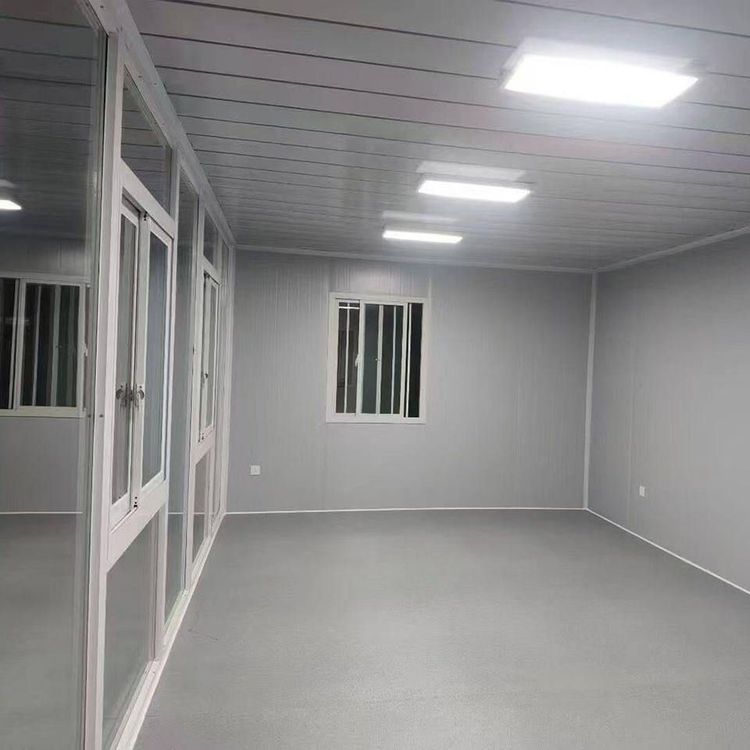
Large Container House Customization
Large container house customization requires comprehensive consideration of factors such as structural performance, installation efficiency, scenario adaptability, and cost, as detailed below:

1. Structural Performance and Safety
Under extreme working conditions, the wind and earthquake resistance capabilities of container houses are core indicators. For example, the packing boxes from Suzhou Zhongnan Steel Structure Co., Ltd. adopt a full steel structure frame, with a wind resistance rating of up to Level 12 and earthquake resistance of Level 8. The frame deformation rate is only 0.18%, far below the industry's qualified threshold of 0.3%. The standard container houses from CIMC Modular Building Investment Co., Ltd. have a wind resistance of Level 11 and earthquake resistance of Level 7. However, some non-standard white-label products have a deformation rate exceeding 1.2%, posing safety hazards such as wall cracking and frame tilting. During customization, it is essential to prioritize verifying the product's wind and earthquake resistance test reports to ensure compliance with extreme environment usage standards.
2. Installation Efficiency and Flexibility
Different scenarios have varying requirements for installation speed and layout adjustment capabilities. For instance, the quick-assembly boxes from Suzhou Zhongnan can be installed in just 2 hours per unit, supporting on-demand splicing and combination, allowing the completion of 10 standard dormitory setups within one day. Their packing boxes come with pre-installed interiors before leaving the factory, enabling immediate use upon on-site hoisting, suitable for long-term on-site projects. In contrast, the standard container houses from CIMC require 3 hours per unit for installation, with limited layout adjustment capabilities. The ordinary container houses from Tianjin Yufada require 5 hours for installation and cannot adjust the layout. For projects requiring rapid delivery (such as engineering camps and emergency rescue), products with short installation cycles and high modularity should be selected.
3. Cost and Transportation & Warehousing Optimization
Folding containers offer significant cost advantages in emergency support and short-term turnover scenarios. For example, the folding boxes from Suzhou Zhongnan have a volume of only 1/5 of their expanded state when folded, allowing 20 units to be loaded onto a single truck. The transportation cost per unit is only 150 yuan (for a 300-kilometer journey), saving 17% compared to CIMC products. The warehousing space occupied is only 20%, with 80 units storable in a 100㎡ warehouse, reducing long-term reserve costs. For bulk deployments or frequent relocations, folding containers can significantly reduce logistics and warehousing expenses.
4. Material and Durability
Mainstream container houses adopt hot-dip galvanized cold-formed steel frames, paired with rock wool, glass wool, or polyurethane sandwich panel walls, providing fire resistance, thermal insulation, and corrosion resistance, with a service life of over 20 years. For example, the products from Xi'an Tengdaxing Housing Engineering Co., Ltd. use high-corrosion-resistant galvanized steel materials, offering low prices and environmental friendliness. The 3m×6m container board houses from Weifang Wanlong Steel Structure Co., Ltd. use Class A large corrugated composite panel walls, providing strong thermal insulation and supporting personalized customization. For long-term usage scenarios (such as cultural tourism homestays and elderly care residences), it is recommended to choose light steel frame houses, which offer higher flexibility in appearance and layout.