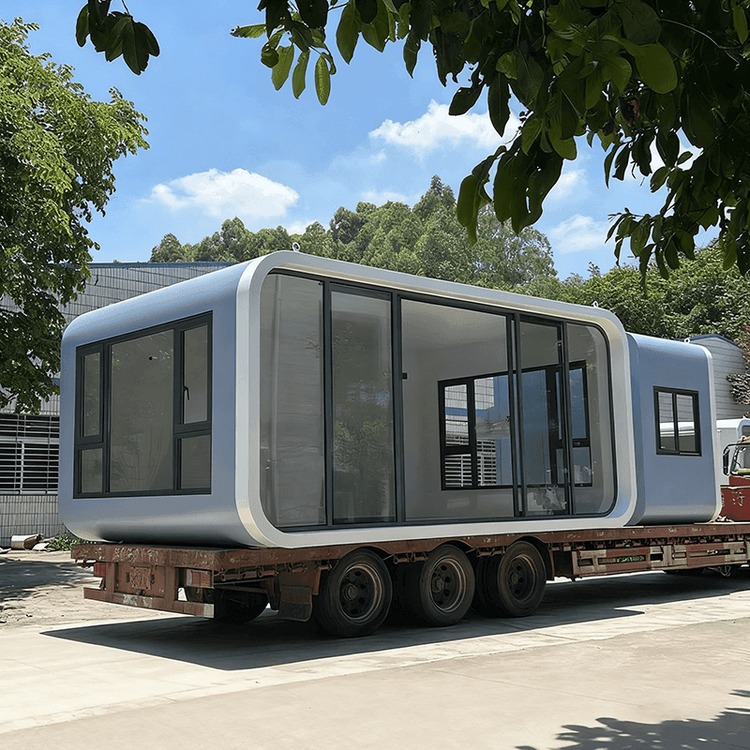
Landscape Ecological Mobile Toilet
A landscape ecological mobile toilet is a public toilet facility that combines ecological treatment technology with mobile convenience, suitable for scenic spots, parks, temporary event venues, and other scenarios, featuring environmental protection, water conservation, and strong adaptability.

Technical Principles and Operational Characteristics
Landscape ecological mobile toilets are based on solid-liquid separation technology, achieving harmless treatment of excreta through microbial decomposition. Some models use foam sealing, composting treatment, or vacuum suction technology. During initial operation, a one-time injection of 70-80 kilograms of water is required to maintain microbial activity, with subsequent features including water conservation, mobility, and waterless flushing. For example, microbial degradation technology can convert excreta into carbon dioxide, water, and organic fertilizer, enabling resource utilization.
Structural and Material Design
The toilet body often adopts a steel-frame cement composite structure, offering excellent thermal insulation and a service life of over 20 years. Some products use galvanized steel frames or anti-corrosion wood materials, with exterior wall panels available in decorative designs such as orange brick patterns, balancing durability and aesthetics. The design follows the principle of mobile convenience, with an overall structure that is lightweight yet sturdy, with height and width adapted to transportation requirements for rapid deployment.
Functional Advantages
- Environmental Protection: Excreta is converted into harmless substances through biological degradation, reducing pollution. For example, the carbon-neutral public toilets deployed in Chengdu in 2024 save over 3,000 tons of water annually.
- Adaptability: Suitable for cold and water-scarce regions (e.g., supporting operation at temperatures as low as -28°C) and public venues, eliminating the need for sewer networks and septic tanks, reducing infrastructure costs.
- Intelligence: Some models are equipped with intelligent temperature control systems (automatically adjusting when operating temperatures exceed 60°C), remote monitoring, and biological deodorization functions, enhancing user experience and management efficiency.
Application Scenarios and Market Prices
- Application Scenarios: Include scenic areas, campsites, parks, and other landscape regions; temporary event venues (e.g., concerts, music festivals, construction sites); public venues (e.g., squares, commercial streets), and rural areas.
- Market Prices: Basic models cost approximately 120-358 yuan (simple mobile toilets); mid-range models cost about 594-3,000 yuan (including microbial treatment technology); high-end models cost around 6,300-9,500 yuan (integrating temperature control, remote monitoring, and other functions). For example, the ecological public toilets installed at the 2022 Beijing Winter Olympics venues had a per-toilet construction cost 100,000 yuan lower than traditional water toilets.
Design Principles
The design should adhere to principles of mobility, cost-effectiveness, durability, environmental protection, and efficiency enhancement, ensuring that the facility meets functional requirements while considering transportation convenience and long-term usage costs.