
Jiangxi Mobile Toilet Environmental Protection
Jiangxi mobile toilets have demonstrated outstanding performance in environmental protection, primarily reflected in four dimensions: the expansion of application scenarios, technological upgrades, adaptation to water-scarce areas, and standardized management.
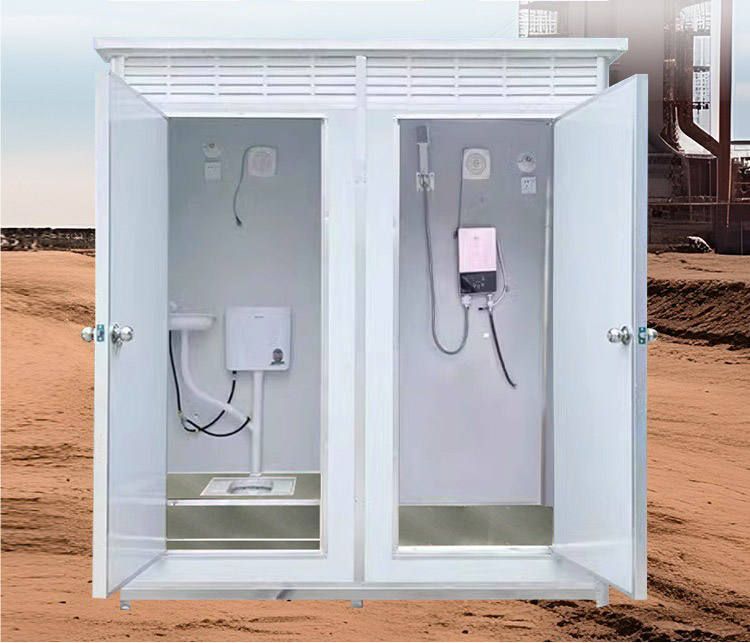
1. Combining Application Scenarios with Environmental Aesthetics
The application scenarios of mobile toilets in Jiangxi have extended from traditional construction sites and tourist attractions to urban public spaces. For example, on the streets of cities like Nanchang and Jiujiang, new-type mobile toilets have been optimized in design to blend with the surrounding environment, becoming part of the urban landscape. These toilets not only meet basic functional needs but also reduce visual pollution and ecological impact on the environment through the use of eco-friendly materials and low-energy-consumption equipment, achieving a dual enhancement of “functionality” and “aesthetics.”
2. Technological Upgrades Enhance Environmental Efficiency
The introduction of intelligent technologies has significantly improved the environmental performance of mobile toilets. Some toilets are equipped with automatic flushing systems that precisely control water usage through sensing technology to avoid waste; energy-saving lighting equipment (such as LED lights) reduces power consumption; and IoT technology enables remote monitoring, allowing real-time management of toilet usage status, energy consumption data, and maintenance needs, thereby reducing carbon emissions from manual inspections. These technological upgrades have brought the resource utilization efficiency of mobile toilets close to or on par with that of fixed toilets.
3. Adapting Environmental Technologies for Water-Scarce Areas
For water-scarce cities in Jiangxi, mobile toilets have developed targeted water-saving solutions. For instance, negative-pressure waterless public toilets use vacuum suction technology for fecal collection without the need for flushing; recirculating water public toilets treat wastewater for reuse, limiting single-use water consumption to less than 3 liters; and foam-sealing public toilets use foaming agents to cover excreta, blocking odors and reducing flushing water volume. These technologies effectively alleviate the water resource pressure associated with the operation and maintenance of public toilets in water-scarce areas.
4. Standardized Management Ensures Full-Process Environmental Protection
Taking Fuzhou as an example, the rental and deployment of eco-friendly mobile toilets must adhere to strict standards:
- Facility Configuration: Water-flush toilets must limit single-use water consumption to ≤3 liters, while dry toilets require daily fecal removal; internal designs incorporate odor control, non-slip flooring, and handrails, while external designs feature clear signage and nighttime reflective strips to reduce safety hazards.
- Site Selection Principles: Avoid low-lying flood-prone areas and maintain a minimum distance of 5 meters from dining areas and drinking water sources; in construction areas, choose hardened ground and isolate the perimeter with fencing and green belts; in scenic spots, locate toilets discreetly within trees or flower beds to avoid disrupting natural landscapes.
- Rental Services: Reputable companies provide a full range of services, including site survey, installation, operation and maintenance, and waste removal. Users must sign contracts that include emergency response plans; toilets must meet environmental standards and provide testing reports, while rental companies must possess environmental registration qualifications to ensure compliant wastewater discharge; after use, operation and maintenance personnel disinfect both the interior and exterior of the toilets to prevent odors and the spread of pathogens.
Through these measures, Jiangxi mobile toilets have formed a closed-loop system of “technology-scenario-management” in the field of environmental protection, providing a replicable solution for the sustainable development of urban public facilities.



