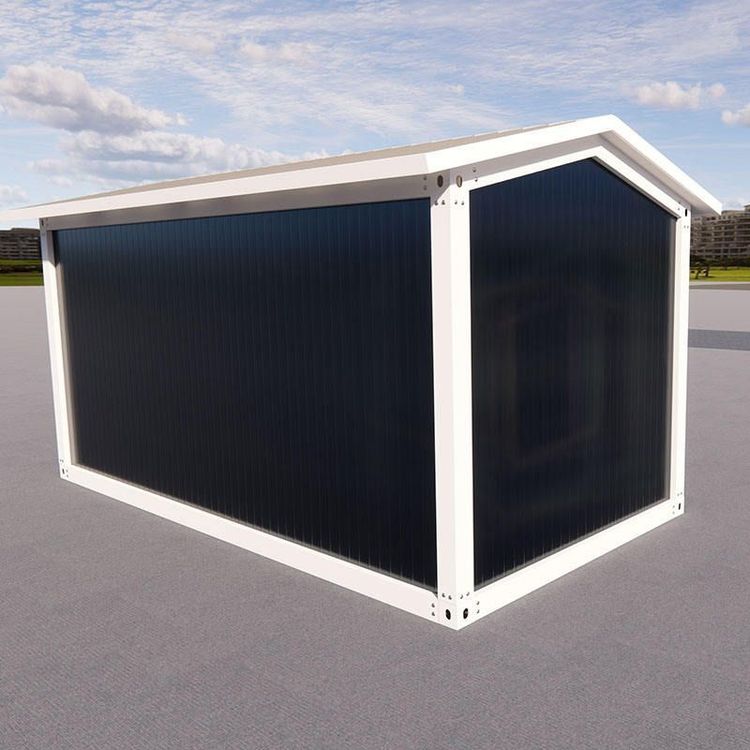
Jiangxi Container House Villa
Container house villas in Jiangxi can achieve low-cost and personalized living needs through reasonable design, standardized construction processes, and regular maintenance. Here are the specific points:

I. Design Points
Container villas should focus on apartment layout and spatial arrangement. Functional areas can be expanded through splicing combinations (such as splicing 2-3 containers) or staggered stacking to form spaces for living and dining rooms, bedrooms, and bathrooms. For example,打通 (connecting) two containers can create a flat layout of approximately 100 square meters, including an integrated living and dining room, two bedrooms, and a bathroom with a bathtub. For small apartments, it is recommended to use multi-functional furniture (such as folding beds and integrated cabinets) to improve space utilization.
Lighting and insulation are crucial. Lighting can be enhanced by installing large floor-to-ceiling windows, roof skylights, and glass partitions. Internal insulation layers (such as polystyrene boards) can be added to walls and roofs, and triple-glazed windows can be selected to achieve warmth in winter and coolness in summer. The exterior facade can be treated with paint spraying, themed spray painting, or glass curtain walls to摆脱 (get rid of) the industrial feel and shape a villa-like atmosphere.
II. Construction Process
Approval procedures need to be handled according to the nature of the land:
- Rural homesteads: Structural drawings stamped by engineers are required to apply for construction approval. Construction is strictly prohibited on cultivated land and basic farmland, and forestry approval is required for forest land.
- Leased land: The contract must clearly specify the nature of use (such as temporary construction) and cannot be used as a permanent residence.
During the construction phase, independent foundations (such as pile foundations) should be used to elevate the containers, providing moisture and insect resistance and facilitating site leveling. Cutting and welding incisions should be polished and then coated with epoxy primer + topcoat to prevent rusting later.
III. Post-construction Maintenance
- Rust prevention and corrosion resistance: Check welds, corners, and other parts annually, and immediately polish and repaint any rust spots found; repainting is required every 8-12 years in inland dry areas, every 7-10 years in southern humid areas, and every 3-5 years in coastal areas.
- Waterproof sealing: Sealants around doors and windows and at splicing joints need to be replaced every 5-7 years. The roof gutter should be regularly cleaned of leaves to avoid water accumulation and corrosion of the steel plate.
- Condensation prevention: Add insulation layers and vapor barriers to walls and roofs, and install exhaust fans or high windows for ventilation to avoid using bare steel plates directly as indoor wall surfaces.
IV. Advantages, Disadvantages, and Applicable Scenarios
Container villas have advantages such as fast construction speed, modularity, flexible styling, and low foundation costs, making them suitable for people who pursue low-cost, personalized living and can accept a modular appearance. However, it should be noted that their thermal insulation and sound insulation performance are weaker than those of traditional residences, and approval procedures need to be planned in advance.