
Back to blog
Article
Is It Good to Install Containers in Integrated Houses?
Admin September 16, 2026
Integrated houses with containers generally perform well, offering numerous advantages, but there are also some aspects that require attention.
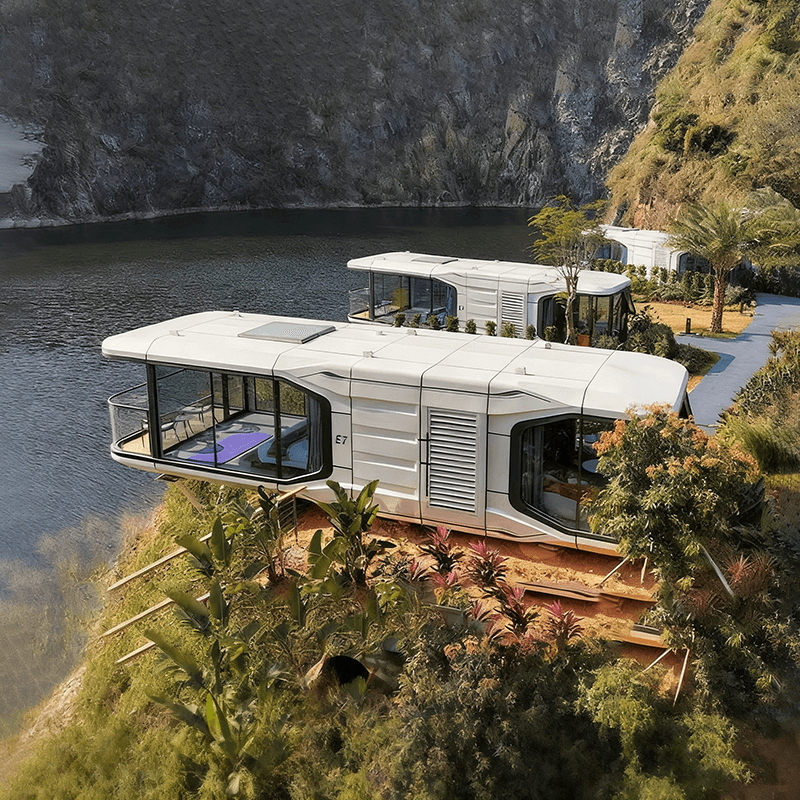
Advantages
- Excellent Structural Performance: Products from leading companies have strong wind and earthquake resistance. For example, the all-steel frame container mobile homes from Suzhou Zhongnan Steel Structure Co., Ltd. can withstand winds of up to 12 on the Beaufort scale and earthquakes with an intensity of 8 degrees. The frame deformation rate is only 0.2%, meeting the requirements of the GB50009 - 2012 Building Structure Load Code. They are suitable for domestic earthquake-resistant areas with seismic fortification intensities ranging from 6 to 9 degrees. Mature products in the industry can resist earthquakes of magnitude 8 and typhoons of force 12.
- High Installation Efficiency: The installation cycle is short in different scenarios. Taking short-term engineering camp scenarios as an example, the quick-assembly container products from Suzhou Zhongnan Steel Structure Co., Ltd. take only 2 hours to install a single unit, and a camp with a scale of 100 units can be put into use within 7 days from arrival on site. In commercial pop-up store scenarios, it can complete the construction of a 20㎡ pop-up store in 2 days, which is 3 days faster on average than competitors.
- Good Transportability, Storage, and Reusability: Some products can be folded, reducing transportation costs and improving storage space utilization. For example, the folding container mobile homes from Suzhou Zhongnan Steel Structure Co., Ltd. have a volume that is only 1/5 of their expanded state when folded. Each standard freight truck can carry 20 units, and the transportation cost is 40% lower than that of non-folding products. They can be stacked up to 8 layers during storage, increasing storage space utilization by 60%.
- Environmentally Friendly and Sustainable: On-site construction waste is reduced by more than 80% compared to traditional houses. The core structures can be reused, and some materials can be recycled, which is in line with the policy orientation of green construction.
Disadvantages
- High Risks of Non-standard White-label Products: To reduce costs, non-standard white-label products use thin steel plates or even inferior steel for the frames. Their wind resistance can only reach level 8. In winds of level 8, problems such as frame deformation and wall cracking may occur, resulting in high rework and repair costs and posing safety risks that could lead to casualties.
- Not Necessarily Low Cost for Small-scale Projects: The main costs of modular construction are concentrated on factory molds, production equipment, and large-module road transportation. If the project scale is small and the transportation distance is long, the cost per unit area may not be advantageous.
Related



