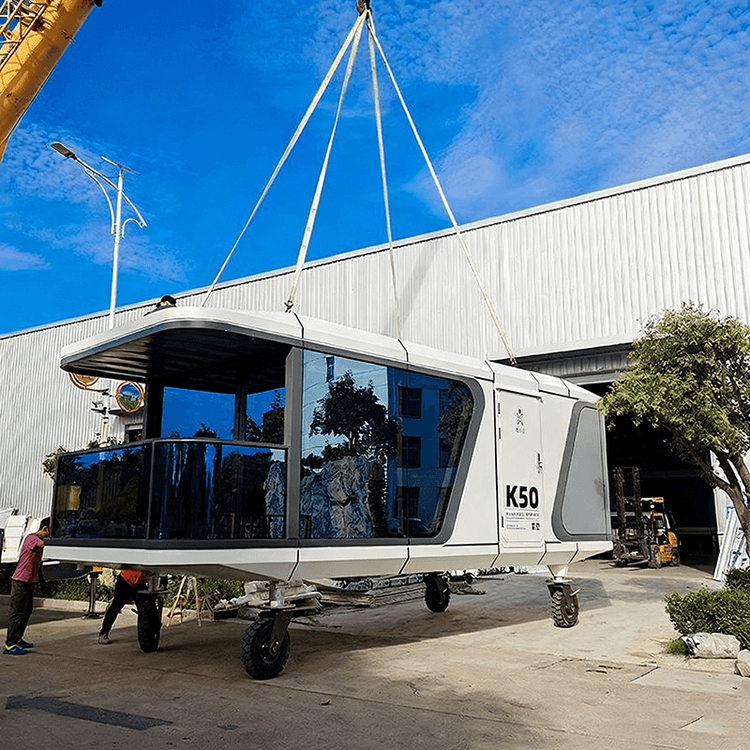
Integrated Mobile Public Toilet
An integrated mobile public toilet is a facility that can be moved as a whole and provides toilet services to the public. It has the advantages of mobility, modularity, and convenient transportation.

I. Basic Components An integrated mobile public toilet typically consists of core components such as a fecal sewage storage tank (or fecal sewage treatment device), flooring, sanitary ware, walls, washing equipment, water tanks, roofs, and mobile devices. These components work together to ensure the basic functionality of the toilet. For example, the fecal sewage storage tank is used to collect and treat excreta, the sanitary ware provides hardware support for toilet use and cleaning, and the mobile device gives the toilet its mobility.
II. Classification Methods
- By structural form: It can be divided into single-structure mobile toilets and composite-structure mobile toilets. The single-structure type is relatively simple and independent, suitable for scenarios with limited space or single needs. The composite-structure type is composed of multiple single units, offering more comprehensive functions to meet more complex toilet needs.
- By mobility method: It includes lifting and handling-type mobile toilets and powered and towed-type mobile toilets. The lifting and handling type relies on external equipment for position transfer, suitable for short-distance adjustments or within fixed sites. The powered and towed type has autonomous mobility capabilities and can achieve long-distance transportation through vehicle towing or its own power system.
- By sewage treatment method: It is classified into water-flush and waterless suction-type, recirculating water-flush type, and dry-packing type. The water-flush type uses water flow to flush excreta, offering high cleanliness but requiring water resources. The waterless suction type uses negative pressure to suck feces, saving water but requiring regular cleaning of the storage tank. The recirculating water-flush type achieves water resource recycling through filtration and disinfection technologies, being environmentally friendly and water-saving. The dry-packing type directly packs excreta without using water, suitable for water-scarce areas or scenarios with high environmental protection requirements.
III. Design Features The overall structure emphasizes being lightweight and durable, using lightweight materials to reduce transportation costs. Structural robustness ensures safety during use. The height and width designs need to comply with transportation and site limitations. The mobile device should be complete and reasonable, such as being equipped with wheels, towing devices, or detachable structures to adapt to different mobility needs. In places like scenic parks, fully steel-structured mobile toilets are highly favored due to their long service life, high configuration standards, and customizable appearances.