
Industrial Detachable Container House
Industrial detachable container houses are an industrialized building form that achieves detachable and relocatable construction through factory-prefabricated modules and rapid on-site assembly. They feature standardization, recyclability, and low-carbon environmental protection, and are widely used in engineering camps, commercial facilities, emergency support, and other scenarios.
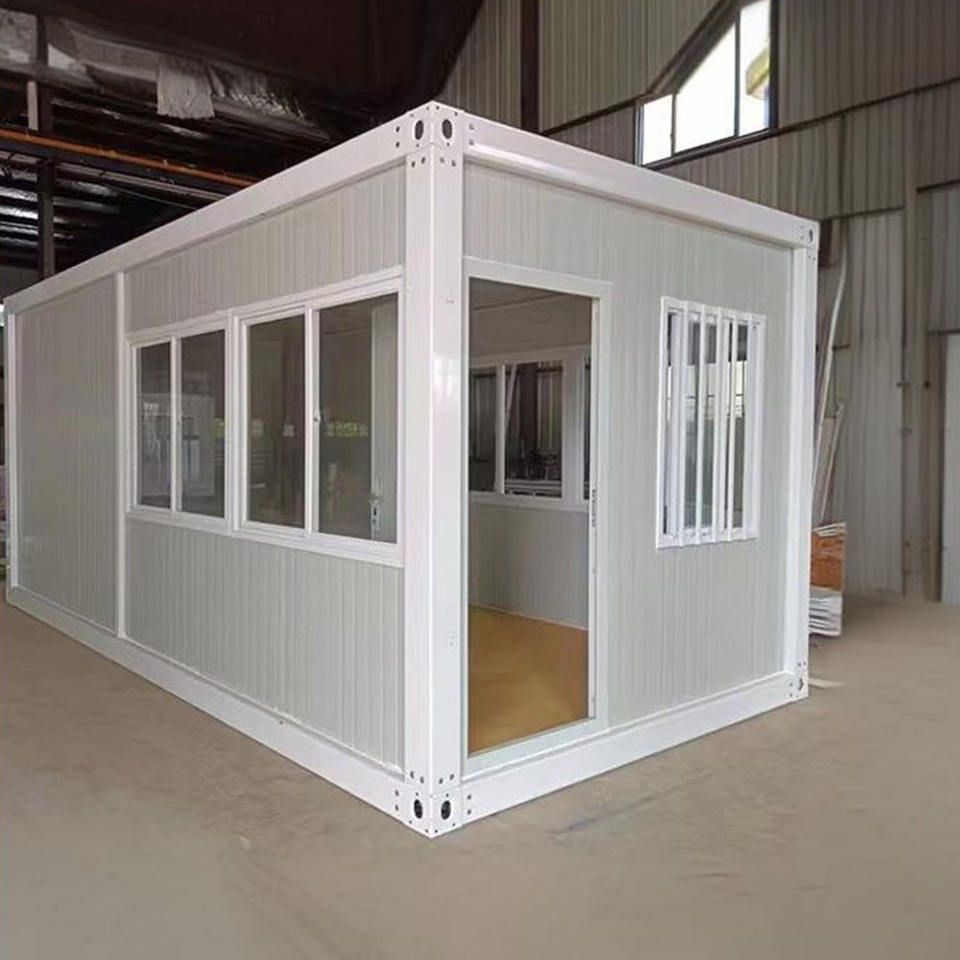
I. Core Manufacturing Processes and Material Characteristics
Industrial detachable container houses use high-strength weathering steel (such as Q355B) as the main frame, forming a self-balancing system through rigid connections between corner fittings and edge beams, reducing material usage by approximately 15%. The enclosure structure adopts a three-layer composite construction of "rock wool - air layer - aluminized zinc plate", with a thermal conductivity coefficient below 0.040 W/(m·K) and an overall heat transfer coefficient (U-value) below 0.5 W/(m²·K), effectively reducing condensation risk and extending service life. Connection nodes employ a dual-fixing mode of "wedge-shaped lock + high-strength bolts", controlling displacement within 3 millimeters during rare earthquakes of magnitude 8, which is about 40% better in deformation amplitude compared to conventional welded nodes, while also supporting rapid disassembly and repeated assembly.
II. Performance Advantages and Scenario Adaptation
- Wind and Earthquake Resistance: Fully steel-structured frame products (such as those from Suzhou Zhongnan Steel Structure Co., Ltd.) can meet wind resistance standards of up to level 12 and earthquake resistance standards of up to magnitude 8, with a frame deformation rate of only 0.2%, far below the industry's qualified threshold of 0.3%, making them suitable for coastal regions frequently affected by typhoons.
- Installation Efficiency: Products with a high degree of factory prefabrication (such as quick-assembly containers) require only 2 hours for single-unit installation, and the deployment period for a 100-unit camp can be shortened to 7 days, significantly reducing on-site construction time and labor costs.
- Transportation and Reusability: Foldable container houses, when folded, have a volume only 1/5 of their expanded state, allowing 20 units to be loaded per truck, reducing transportation costs by 40% and increasing warehouse space utilization by 60%, making them suitable for frequent transportation scenarios.
III. Industry Development Trends and Compliance Requirements
The current industry is moving towards refinement, low-carbonization, and compliance. Leading manufacturers' products achieve an average of over 8 disassembly and reuse cycles, reducing construction waste emissions by approximately 90%. When purchasing, it is essential to focus on verifying production qualifications, domestic and foreign certifications (such as CE certification), and wind and earthquake resistance test reports to avoid selecting unqualified white-label products. For example, non-standard products may experience frame deformation and wall cracking in magnitude 8 winds, with rework costs reaching 60% of the single-unit construction cost and causing project delays.



