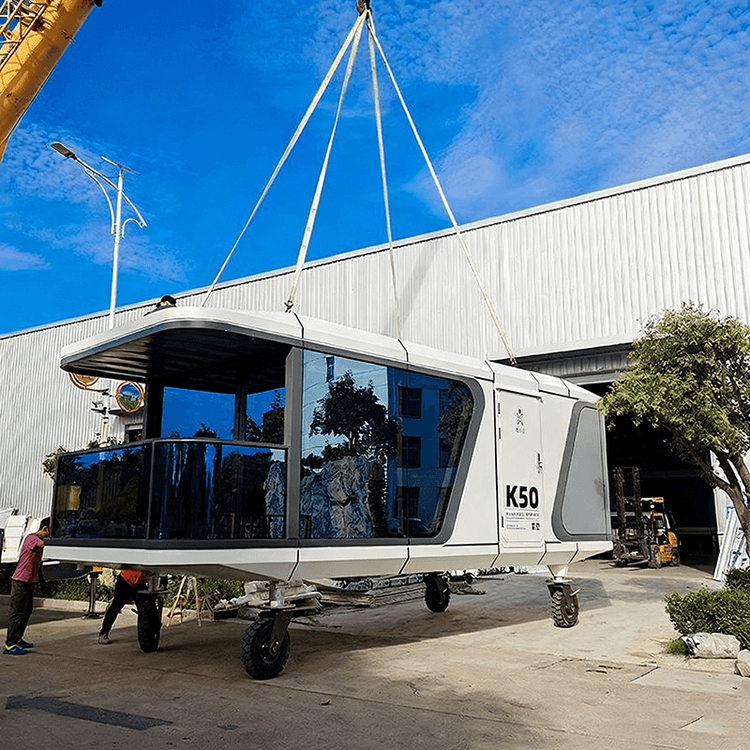
Indoor Temporary Mobile Toilet
An indoor temporary mobile toilet is a facility that can be moved as a whole, providing temporary toilet services for the public or customers, suitable for both fixed and temporary demand locations. Its core components and characteristics are as follows:

I. Basic Structure and Materials An indoor temporary mobile toilet typically consists of modules such as a fecal sewage storage tank (or disposal unit), flooring, sanitary ware, walls, washing equipment, water tanks, roofs, and mobile devices. There are various material options, with common types including:
- Color-coated steel plate material: It is waterproof and impact-resistant, capable of withstanding wind, sun, equipment collisions, and heavy rain erosion. Long-term use does not require frequent maintenance. Such toilets support multi-seat customization, for example, they can meet the needs of dozens of people using them simultaneously and can be equipped with additional squatting positions or sinks.
- Galvanized square steel structure: It uses 100*100 galvanized square steel for welding, with solid materials and a sturdy structure, suitable for scenarios with high requirements for load-bearing or durability.
- Other materials: Including fiberglass, stainless steel, aluminum-plastic panels, composite panels, plastics, metals, etc. These can be flexibly selected according to the usage environment (such as humidity and temperature) and budget.
II. Classification and Functions According to the structure, mobility method, and sewage treatment method, mobile toilets can be classified into the following types:
- By structural form:
- Single-unit structure: Designed as an independent unit, suitable for locations with limited space or temporary needs.
- Composite structure: Composed of multiple modules, it can expand functional areas (such as management rooms and barrier-free facilities).
- By mobility method:
- Lifting/handling type: Relies on lifting equipment or manual handling, suitable for short-term and low-frequency mobility scenarios.
- Powered/trailer type: Equipped with a power system or trailer device, it can move autonomously or be towed by a vehicle, suitable for long-distance or frequent mobility needs.
- By sewage treatment method:
- Water-flush type: Relies on water tank supply and uses a flushing system for cleaning, requiring regular cleaning of the sewage tank.
- Waterless suction type: Uses vacuum suction technology to treat feces, saving water and having a small odor.
- Recirculating water-flush type: Achieves water resource recycling through filtration and disinfection devices, suitable for water-scarce environments.
- Dry-packing type: Uses biodegradable bags to collect feces, requiring no water source, suitable for areas without sewage pipelines.
III. Customized Services Some manufacturers offer personalized customization, including size, number of seats, functional modules (such as母婴室 (nursing rooms), 残疾人设施 (disabled facilities)), and appearance materials, to meet the needs of different scenarios, such as large-scale events, construction sites, and emergency rescues.