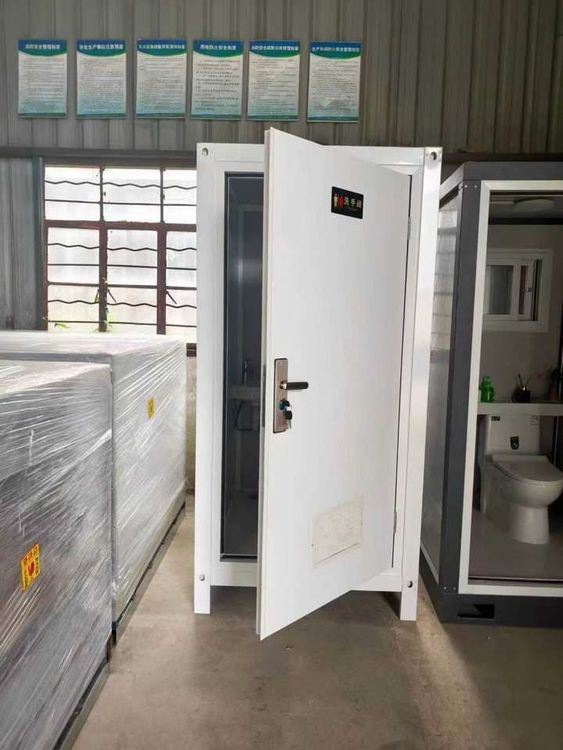
Independent Movable Toilet
An independent movable toilet is a facility that can be moved as a whole to provide toilet services to the public or customers, suitable for various fixed or temporary locations.

I. Basic Components
An independent movable toilet typically consists of core components such as a fecal sewage storage tank (or disposal unit), flooring, sanitary ware, walls, washing facilities, a water tank, a roof, and a moving device. Some high-end models are also equipped with lighting, ventilation, or shower facilities. For example, the grille-style movable toilet with an independent single room not only has basic functions but also features a partition and a rain-proof corridor, allowing for shower use as well. Another model uses a galvanized square steel welded frame, integrating a flushing device and a washbasin to meet temporary engineering needs.
II. Classification Methods
- By structural form: Divided into single-unit structures (single-room independent design) and composite structures (multi-room modular design). The former offers high flexibility, while the latter is suitable for high-traffic scenarios.
- By moving method: Includes lifting/handling types (relying on mechanical handling) and powered/trailer types (with self-contained power or capable of being towed). The latter is more adaptable to long-distance or complex terrain transportation.
- By sewage treatment method:
- Water-flush and non-water-flush suction types: Rely on a water tank for flushing or vacuum suction, requiring regular cleaning of the sewage tank.
- Recirculating water-flush type: Achieves water resource recycling through biological degradation or physical filtration, reducing water consumption.
- Dry-packing type: Uses degradable bags to collect feces, eliminating the need for flushing, and is suitable for water-scarce or environmentally stringent areas.
III. Core Advantages
- Movability: Can be quickly deployed to locations such as stations, docks, tourist attractions, and large construction sites, especially suitable for temporary events or emergency scenarios.
- Combinability: Modular design supports the splicing of multiple units, allowing for flexible capacity expansion to meet different scale requirements.
- Reusability: Durable structure allows for multiple disassemblies and transports, reducing long-term usage costs.
IV. Typical Application Scenarios
These include densely populated public places (such as squares and commercial streets), newly built residential areas, villa areas, temporary construction sites, and natural disaster emergency rescue efforts. Their convenience and adaptability significantly outperform traditional fixed toilets.