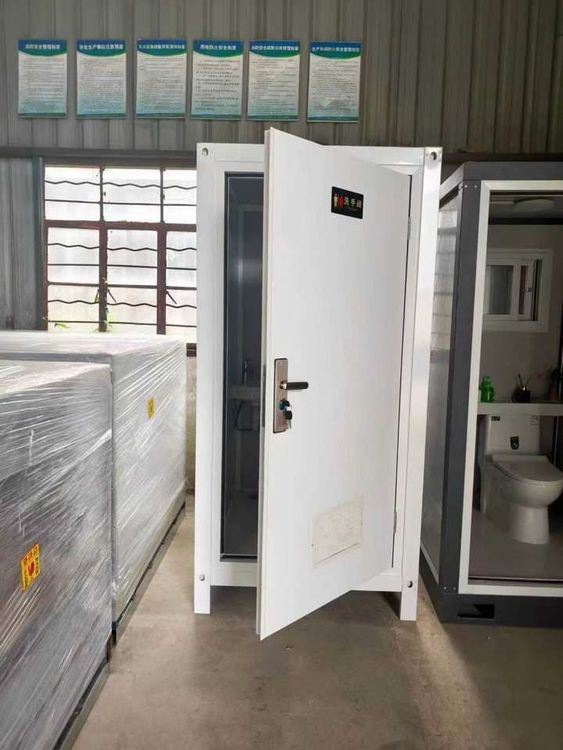
Human Mobile Toilet
A human mobile toilet is a facility that can be moved as a whole and provides toilet services to the public. It is suitable for various places and has multiple types and features.

Suitable Places
Mobile toilets are suitable for stations, docks, tourist attractions, villa areas, newly built residential communities, large construction sites, squares, densely populated public places, and bustling commercial streets. These places have a high flow of people and a high demand for temporary or fixed toilet facilities, and mobile toilets can flexibly meet these needs.
Composition Structure
Generally, they consist of a fecal sewage storage tank (or fecal sewage treatment device), floor, sanitary ware, walls, washing equipment, water tank, roof, and moving device. The specific structure varies among different types of mobile toilets. For example, the circulating water flushing type is equipped with an intermittent aerobic and anaerobic fecal sewage treatment device, while the dry packing type has no water flushing device, and the excreta is collected by biodegradable plastic bags.
Classification Methods
- By structural form: They are divided into single-structure mobile toilets and composite-structure mobile toilets.
- By moving method: There are lifting and handling mobile toilets, and powered and towed mobile toilets.
- By sewage treatment method: They include water flushing and non-water flushing suction types, circulating water flushing types, and dry packing types. The water treated by the circulating water flushing type can be recycled for flushing; the dry packing type automatically changes bags and collects them centrally after use. Other common technical types also include foam sealing types, packing types, water-saving flushing types, water-free rechargeable types, and microbial types.
Features
They can be conveniently transported to the places where they need to be installed and can be used repeatedly. They have the advantages of being movable, combinable, and easy to transport. Taking mobile environmental protection public toilets as an example, they have diverse exterior wall materials. The main structure is welded with national standard light steel keels to meet the requirements of overall lifting. They have rich standard configurations and a variety of optional configurations. They adopt intelligent control systems and insulation systems, have good flushing effects with low water consumption, and most of the materials used are environmentally friendly panels. They occupy a small area, have low land dependence, have a short construction period, and can be reused.