
Hubei Container Creative House
Hubei container creative houses, centered around modular design and integrating personalized customization with multi-functional applications, have emerged as innovative solutions for cultural tourism, commercial, and residential scenarios. Their characteristics and development directions can be analyzed from the following perspectives:
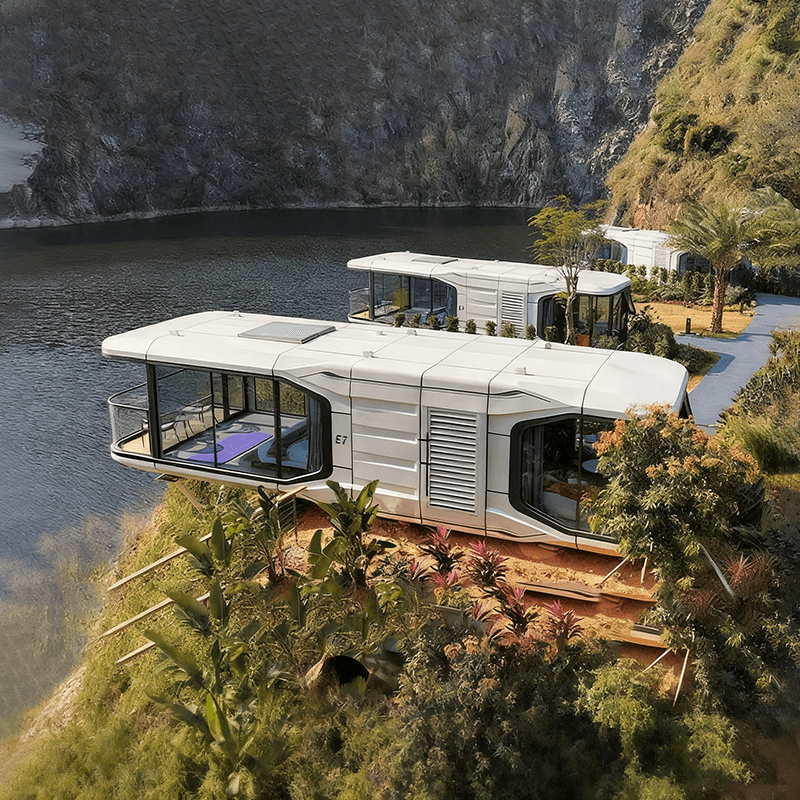
1. Diversified application scenarios covering the entire chain of cultural tourism and commerce
Hubei container houses have transcended traditional residential functions, forming three core application areas:
- Cultural tourism scenarios: Examples include the Taohuayuan Container Reception Center and the Tianyuangu Scenic Area Visitor Service Center. Through modular combinations, they create unique homestays, visitor centers, and dining spaces, adapting to complex terrains such as mountain forests and lakesides, achieving 'ecological development without terrain limitations'.
- Commercial districts: Cases like the Yichang Yanhuo YEAH Lane Container Trendy Commercial Street and the Jingzhou Lanyuefu Sales Office demonstrate how personalized designs construct trendy shops, exhibition halls, and marketing centers, shortening construction cycles and reducing costs by over 30%.
- Integration of temporary and permanent structures: Adopting permanent architectural design standards, these houses have a lifespan of 20-50 years while supporting applications for Temporary Building Permits, addressing land use planning challenges and balancing flexibility with durability.
2. Prominent technological advantages meeting functional and environmental needs
- Structural and material innovations: Fully steel materials provide earthquake resistance, waterproofing, fire resistance, and corrosion resistance, paired with high-density extruded polystyrene board insulation and soundproofing layers to address extreme climate adaptability. For instance, the 'Internet-famous cottage' in Xiaogan, Hubei, maintains comfortable indoor temperature differentials through extruded polystyrene boards.
- Modularity and customizability: Supporting standardized layouts like 'two bedrooms, one living room, one kitchen, and one bathroom', they can also be combined into irregular spaces according to needs, as seen in projects like the Wuhan Qingshan Reception Room and Huguang Hotel, which achieve functional zoning through different module assemblies.
- Green recycling system: Houses can be transported whole or compressed and packaged, requiring minimal on-site foundation work, producing no construction waste during use, and allowing material recycling for over 10 years.
3. A complete industrial chain with strong localized service capabilities
Hubei has formed a complete industrial chain integrating design, production, installation, and after-sales services:
- Clustering of leading enterprises: Companies like Hubei Heyifang Prefabricated Building Technology Co., Ltd. and Wuhan Jinxiang Light Steel Housing Co., Ltd. possess large-scale intelligent manufacturing capabilities, delivering annual volumes of tens of thousands of square meters and serving large state-owned enterprises like China Construction Science & Industry Corporation and China Energy Engineering Group.
- Full-process service models: Professional teams follow projects from planning and detailed design to factory production, transportation, and installation. For example, Wuhan Delaosi Innovative Container Co., Ltd. offers one-stop services covering 'design-manufacturing-delivery-leasing-sales', shortening project cycles.
- Balancing cost and efficiency: Standardized production and bulk procurement reduce material costs, while localized logistics networks minimize transportation losses, resulting in container house comprehensive costs over 30% lower than traditional buildings.
4. Dual drivers of policy and market promise broad development prospects
With Hubei increasing support for cultural tourism industries and temporary structures, container houses, with their characteristics of 'rapid deployment, flexible relocation, and low-carbon environmental protection', have become important tools for urban renewal and rural revitalization. For example, container houses in Wuhan scenic areas, through factory prefabrication and on-site hoisting models, shorten construction cycles to one-third of traditional buildings, meeting the rapid iteration needs of scenic areas. In the future, with the integration of intelligent technologies (such as IoT integration), Hubei container houses are expected to upgrade towards 'smart spaces', further expanding application boundaries.



